
Last Updated: September 14, 2026
Calculate Your Off-Grid Daily Balance:
Match your daily appliance watt-hours against solar harvesting. Tally appliance loads with the RV Daily Power Calculator, and model your net battery autonomy with the Daily Solar Power Balance Calculator.
Every RV owner sizing up a first solar system eventually hits the same fork in the road: bolt panels to the roof, buy a portable folding panel, or run some mix of both. RV solar retailers sell both. RV forums argue about both. The honest answer is that neither option is objectively better — they solve different problems. A roof-mounted panel charges automatically wherever you park and never eats into interior storage. A portable panel can walk out from under a shade tree into full sun, at the cost of somebody actually carrying it there and back each day. Which one makes more sense for a specific RV comes down to four practical factors: how much shade your typical camping spots have, how much roof space your rig has to spare, how much weight and cost you're willing to add, and how much daily setup effort you're willing to do.
How Each Setup Actually Works
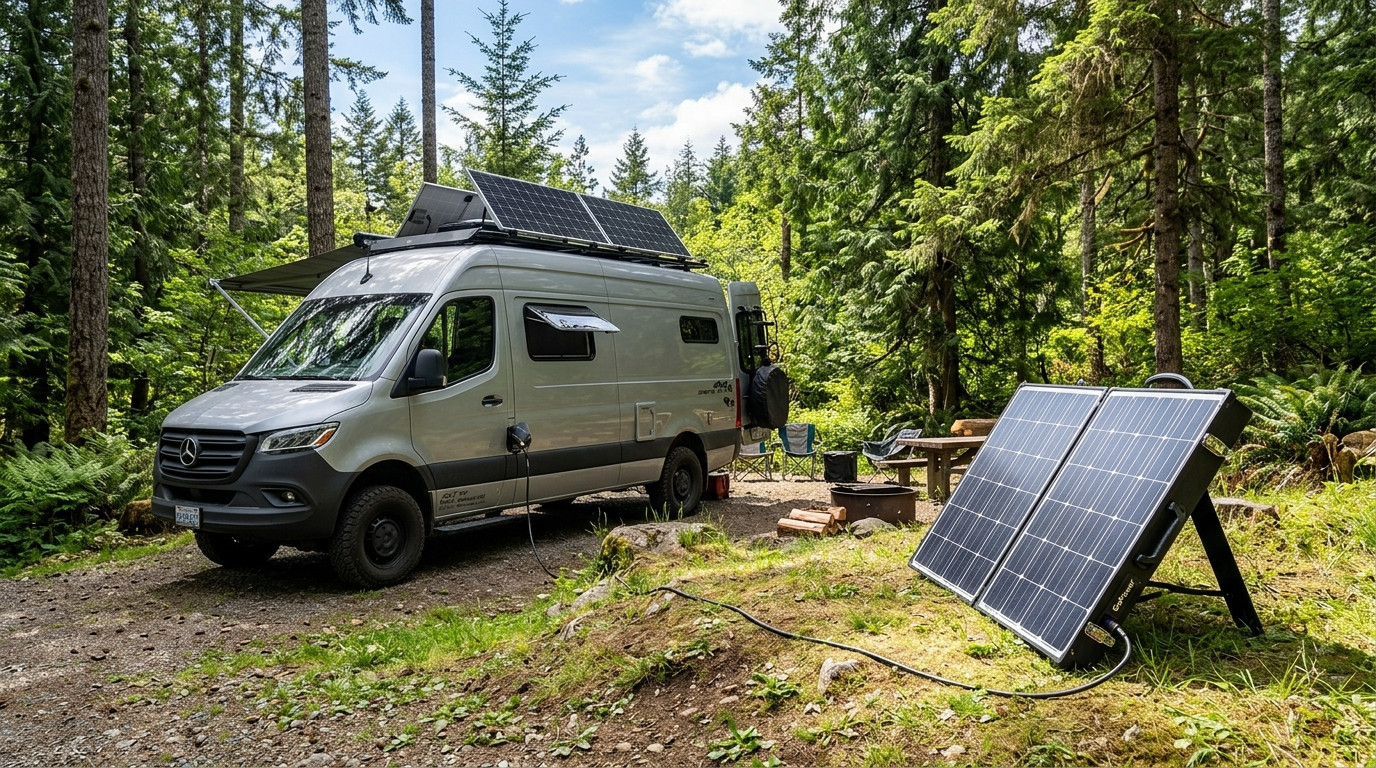
A roof-mounted system is a fixed installation: one or more rigid or flexible panels bolted or adhered to the RV roof, wired through a roof entry gland down to a charge controller and battery bank. Once installed, it works passively — the panel produces power whenever the sun hits the roof, whether the RV is parked at a campsite or driving down the highway.
A portable panel is a self-contained unit, usually a folding 100-200 watt "suitcase" on hinged legs, often with its own built-in charge controller in the case. It sits on the ground, a table, or a rock wherever the sun is best, connected to the RV through either a dedicated exterior solar port or alligator clips run to the battery compartment. It has to be set out and packed away by hand at every stop.
Shade Flexibility: The Biggest Real-World Difference
A roof panel is stuck wherever the RV is parked. If that spot has partial shade from trees, a canyon wall, or even the RV's own roof vents and AC unit at certain times of day, output can drop by more than the shaded fraction would suggest — solar cells are wired in series inside a panel, so a shadow across even part of a cell can pull down the output of the whole string, not just the shaded portion. Many boondockers deliberately look for shaded parking to keep the RV's interior cooler, since full sun on the roof can raise interior temperatures noticeably and make the air conditioner work harder. That puts roof panels in a genuine bind: park in the sun for better charging, or park in the shade for a cooler cabin.
A portable panel sidesteps that trade-off. Park the RV wherever it's comfortable, then walk the panel out to a clear patch of sun twenty or thirty feet away. This is the single most common reason experienced boondockers give for owning a portable panel even when their roof already has a solid array — it solves a problem a fixed panel structurally can't.
The catch is that the flexibility has to be used to count. "Walking it out" is manual labor performed every day you want the benefit, and if the best sun spot is uphill, across a ravine, or against campground rules, the advantage disappears.
Setup and Breakdown Time
Roof panels need zero daily setup, which is their core convenience. Portable panels require unfolding, positioning, angling toward the sun, and running a cable — then reversing the whole process before driving off. Leaving a portable panel behind at a campsite is a common and expensive mistake reported repeatedly across RV forums. For a single overnight stop, that setup overhead can outweigh the shade benefit. For a multi-day or multi-week boondocking stay, a few minutes each morning is a much smaller share of the trip. Portable panels generally earn their keep more on long stays than on fast-moving travel days.
Weight: On the Roof vs In Storage
Weight shows up in two different places depending on which system you choose, and it matters for different reasons in each.
A rigid glass roof panel in the common 100-watt class typically weighs somewhere in the 13 to 17 lb range, based on the spec sheets of widely sold monocrystalline panels. That weight sits on the roof permanently, which matters for the RV's overall payload — the same weight budget shared with water, propane, and gear — though a handful of panels rarely pushes a roof anywhere near its load limit. Flexible, adhesive-mounted panels cut that weight by roughly half to three-quarters, which is one reason they're popular on smaller vans and curved-roof rigs, though they typically run somewhat less efficient and shorter-lived than rigid glass panels.
A portable "suitcase" kit — two 50-watt panels hinged together, folding legs, and usually a built-in charge controller — tends to weigh more per 100 watts than a bare rigid roof panel, often landing in the 20 to 27 lb range once the stand, hinges, and controller housing are included. That weight doesn't count against roof load, but it does have to be lifted, carried, and stored somewhere inside the RV — usually a basement compartment or wet bay — every time the rig moves.
Cost: What You're Actually Paying For
Panel-for-panel, a rigid 100-watt roof panel and a 100-watt portable suitcase kit often land in a similar retail price range, roughly $100 to $200 depending on brand and sale timing. That comparison is a little misleading, though, because a portable kit usually already includes its charge controller, folding stand, and cable, while a roof installation needs those bought and installed separately — mounting brackets, a roof cable entry gland, a controller, and, for a first-time roof penetration, possibly installation labor. A portable kit is close to plug-and-play the day it arrives. On the other hand, expanding a roof array later — adding a second or third panel to a system already installed — is usually cheaper per watt than buying a second complete portable kit, since there's no duplicate stand or controller to pay for again.
Roof Space: How Much Power You Can Realistically Fit
How much solar a roof can hold depends entirely on the rig. A standard camper van typically has room for four or five 100-watt panels before running out of usable roof, while larger high-roof vans can fit eight or nine. Travel trailers and fifth wheels usually have more open roof to work with — enough that widely cited RV solar sizing guidance from AM Solar recommends roughly 150 to 500 watts of roof solar depending on how conservatively a household uses power, and boondockers running lithium-heavy, air-conditioner-capable setups sometimes exceed 1,000 watts. Some factory-installed packages on large fifth wheels now ship with well over 1,700 watts across eight panels straight from the manufacturer, which shows how much capacity a big rig's roof can genuinely hold once vents, AC units, and antennas are worked around.
Roof space runs out fastest on smaller rigs — truck campers, teardrop trailers, and compact vans — where two or three panels can fill the available flat roof area before reaching the wattage a full-time boondocker might actually want. That's exactly the situation where a portable panel stops being a nice-to-have and becomes the only practical way to add more solar capacity at all, since there's simply no roof left to bolt anything else to.
A Quick Example: When a Portable Panel Actually Closes the Gap
Say a travel trailer's roof array comfortably covers daily needs in full sun, but a favorite boondocking spot has enough tree cover that the roof panels sit shaded for a good part of the afternoon. Setting a single 100-watt portable panel in a clear patch of sun for around four hours of strong midday light would, in theory, put in roughly 400 watt-hours (100W × 4h). In practice, charge controller conversion losses, cable resistance, and an imperfect sun angle typically take off somewhere around 20 to 30 percent of that, landing closer to 280-320 watt-hours actually reaching the battery. That's a meaningful offset to a shaded roof array, not a replacement for it. The exact number moves with cloud cover, panel angle, and time of year — the point isn't the specific watt-hour figure, it's that a portable panel is realistically a supplement that closes a shading gap, not a second full system.
Which Setup Fits Your RV
Camper Vans and Truck Campers
Roof space is the scarce resource here, and interior storage is even scarcer. Most van and truck camper owners get the most value from maximizing roof-mounted wattage first, since every watt not on the roof has to live somewhere inside a rig that's already tight on room. A portable panel still earns a place for full-time van dwellers who move parking spots often and want a way to top off power on cloudy or shaded days without repositioning the whole vehicle — but it's usually a supplement added after the roof is already maxed out, not the primary system.
Travel Trailers and Fifth Wheels
These rigs usually have enough roof real estate that the shade-flexibility argument for a portable panel gets stronger, not weaker — there's already comfortable wattage on the roof, so a portable panel's job becomes purely about chasing sun around a shaded campsite during multi-day stays, which is exactly where portables perform best. Many trailers and fifth wheels ship pre-wired with an external solar port for this reason, letting an owner plug in a portable panel without touching the interior wiring at all.

Motorhomes (Class A, B, and C)
Motorhome roofs carry more built-in obstructions — AC units, vents, satellite domes, ladders — so usable flat space per square foot tends to be lower than on a similarly sized trailer roof, even though total roof area is large. Motorhomes are also more likely to be driven between overnight stops rather than parked in one shaded spot for a week, so the daily-setup cost of a portable panel is paid more often relative to the benefit. Roof-mounted solar remains the default for most motorhome owners, with a portable panel as an occasional add-on rather than a core part of the system — some manufacturers even build in a portable-panel port alongside the standard roof array for exactly this occasional use.
Why Many RVers End Up With Both
RV solar forums are full of owners who didn't pick one system and stop there — they started with a roof array sized for typical conditions, then added a portable panel later for the specific situations a fixed roof panel can't solve: deep shade, an undersized factory-installed array, or extra capacity for a power-hungry accessory. A roof array covers the baseline; a portable panel covers the exceptions. This combination shows up often enough in real installations — including trailers and fifth wheels that ship from the factory with a solar port built in specifically for this purpose — that it's worth treating as a legitimate third option rather than just splitting the difference between the other two.
A Few Practical Notes Before You Decide
Roof installation means drilling into the one part of the RV specifically designed to keep water out, so a sealed, well-executed entry point matters more than which panel brand gets chosen — a poorly sealed roof penetration is a far more common source of regret than the panel-type decision itself. If you're not confident doing that work, it's worth having a qualified RV technician handle the roof penetration and wiring, even if the panels themselves get mounted by hand.
Portable panels carry a different risk: they sit outside, unattended, connected by a cable that's easy to unplug. Several RV forum threads mention portable panels going missing at unsecured sites. A cable lock, or simply keeping the panel within sight, reduces that risk considerably.
Bottom Line
There's no universally better option here, only a better fit for how a specific RV actually gets used. A rig with tight roof space and an owner who moves often leans roof-first. A rig with roof space to spare, an owner who settles into shaded boondocking spots for days at a time, and a budget for a second system leans toward adding a portable panel to what's already on the roof. For most travel trailers and fifth wheels with room to spare, that combination — a solid roof array plus one portable panel for shade days — tends to be the setup people actually keep using instead of upgrading again a year later.
Roof-Mounted vs Portable: Quick Comparison
| Factor | Roof-Mounted | Portable |
|---|---|---|
| Daily setup effort | None — passive once installed | Unfold, position, and pack away at every stop |
| Shade flexibility | None — fixed wherever the RV parks | High — can be moved into full sun |
| Typical weight per 100W | 13-17 lbs (rigid glass panel) | 20-27 lbs (panels, stand, and controller) |
| Where the weight counts | Against RV payload, permanently | Against interior storage space, while traveling |
| Roof space needed | Yes — competes with vents, AC, antennas | None |
| Theft/loss risk | Low — bolted down | Higher — sits outside unattended |
| Best fit | Rigs with limited roof space, frequent movers | Rigs with roof space to spare, long shaded stays |
Sources: AM Solar's RV solar sizing guidance via RVtravel.com, Renogy's guide to rigid, flexible, and portable solar panels for campervans, and Unbound Solar on how partial shading affects panel output.
Undersized cables create dangerous voltage drops in 12V RV systems. Calculate your array with our RV Solar Sizing Calculator, and size safe cables and inline fuses with the Wire Gauge & Voltage Drop Calculator.