
Don't guess your electrical needs. Use our interactive RV Daily Power Calculator to tally your 12V and 120V appliances, or test your setup with the Daily Solar Power Balance Calculator to see if tomorrow's sun will cover your consumption.
Calculate Your Off-Grid Daily Balance:
Match your daily appliance watt-hours against solar harvesting. Tally appliance loads with the RV Daily Power Calculator, and model your net battery autonomy with the Daily Solar Power Balance Calculator.
What an RV Solar System Can Actually Power — And What's Unrealistic
If you're new to RV solar, the most useful thing you can learn is not what a panel can do, but what it actually does in real conditions — and which appliances quietly need more energy than most people expect.
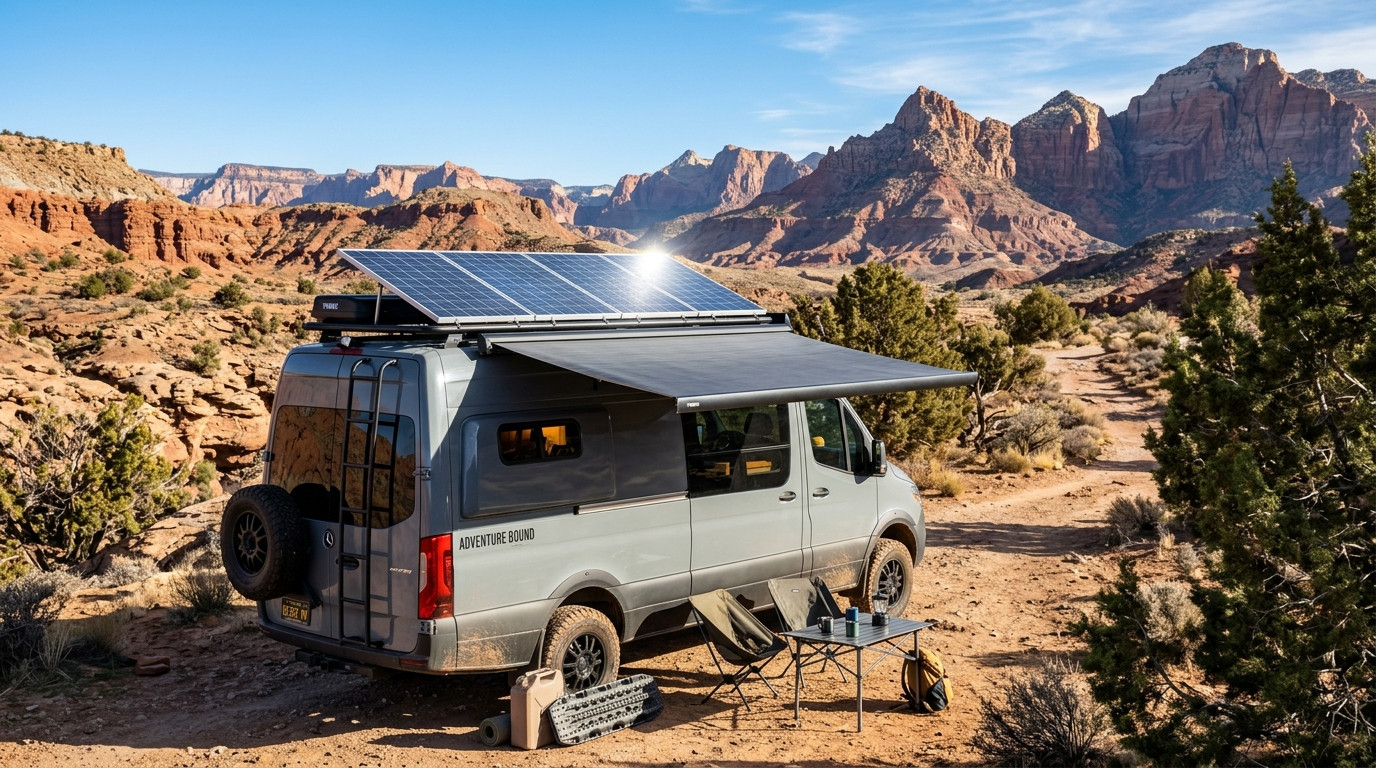
A 200W solar system can genuinely keep a refrigerator, LED lights, a roof fan, a laptop, and phone charging running on most sunny days. A 400W system can handle a medium travel trailer with more fan hours, occasional AC loads through an inverter, and a larger battery bank. But neither can reliably power an air conditioner, a microwave for dinner, or an electric water heater — not without serious battery storage, a large inverter, and ideal weather.
This article gives a realistic load-by-load breakdown, the assumptions behind it, and a simple decision framework so you can set expectations before you buy anything.
How the Numbers Work (Simple)
Solar is a daily energy budget, not a peak-wattage promise.
Daily Wh = Panel Watts × Peak Sun Hours × Real-World Efficiency
A realistic planning factor for flat RV roof panels in real-world shade, heat loss, and wiring is about 75% of rated wattage — so 200W of panels in 4 peak sun hours yields roughly 600 Wh/day, not 800 Wh.
| Panel array (rated) | Realistic daily yield (4 PSH, ~75%) | What it can cover |
|---|---|---|
| 200W | ~600 Wh | Fridge, LED lights, fan, devices |
| 400W | ~1,200 Wh | Above + laptop, more fan, light inverter use |
| 600W | ~1,800 Wh | Above + occasional AC start, microwave (short) |
These are planning ranges, not guarantees. Shade, season, temperature, and roof angle all shift the real number down.
Can RV Solar Reliably Run Each Load?
| Load | Realistic on solar? (200–400W) | Notes |
|---|---|---|
| 12V compressor fridge | Yes (most common load) | 50W average over 8–10h duty cycle = ~400–500 Wh/day |
| LED cabin lights | Yes | 10–25W total for 4–5h = 40–125 Wh |
| Roof fan (30–45W) | Yes | 6h = 180–270 Wh; hot days = more hours |
| Laptop + charging (AC via inverter) | Yes, with margin | 60W × 4h = 240 Wh; add ~15% inverter loss |
| Water pump (short runs) | Yes | 50W × 0.5h = 25 Wh; tiny impact |
| Microwave (1,000W, 10–15 min) | Only with large bank + inverter | ~250 Wh in 15 min; needs 2,000W+ pure-sine inverter |
| Air conditioner (1,200–1,500W continuous) | No — generator needed | Requires 3,000W+ inverter plus 2,000+ Wh battery; not a solar-only task |
| Electric water heater | No — generator or shore | 1,200–1,500W continuous; solar can't cover this alone |
| Induction cooktop | Rarely — generator better | 1,800W+; battery drains fast |
The pattern is simple: low-watt, long-time loads (fridge, fan, lights) fit solar well. High-watt, short-time loads (microwave) only work with large battery + inverter. Continuous high-watt loads (AC, electric heat, water heater, cooktop) need generator or shore power.
The Hidden Real-World Issues
- Inverter loss: AC devices through an inverter need ~15% more battery energy than the device rating. A 60W laptop needs ~70W from the battery.
- Battery depth of discharge: Lead-acid only gives ~50% of rated capacity; lithium ~80–100%. A 100Ah lead-acid bank = ~600 Wh usable at 12V.
- Weather: Cloudy days can drop production to 10–25% for a full overcast stretch — battery reserve is what carries you.
- Temperature: Panel efficiency drops ~0.5% per °C above 25°C; hot-roof panels underperform on the hottest days you need them most.
Quick Decision Framework
Match your array to your actual appliance list, not a generic spec sheet.
Light weekend (2 nights, minimal inverter): 200W + 100Ah lithium = fridge + fan + lights + device charging + some shade margin.
Medium boondock (3–5 days, some AC loads): 400W + 200Ah lithium + 2,000W pure-sine inverter = above + laptop/inverter loads + microwave on good sun days.
Full-time / high-load: 600W+ array + 300Ah+ lithium + generator for AC/heat. Solar reduces generator hours; it doesn't eliminate them.
Don't size for the perfect sunny day. Size for a cloudy day with 25% solar and still enough battery to cover your critical loads overnight.
Bottom Line
RV solar is excellent at the loads that matter for comfortable boondocking: cooling (fan), refrigeration, lighting, light electronics, and phone/device charging. It is not a universal replacement for generator or shore power — especially for continuous high-watt appliances. Set expectations around real daily Wh, real weather, real battery usable capacity, and real inverter losses, and the system you build will actually work.
Next logical read: How Much Electricity Does an RV Use Per Day? (Day 11) — the worksheet to turn these load estimates into your actual daily Wh budget.