
This post contains affiliate links — if you buy through them, we may earn a commission at no extra cost to you.
Last Updated: September 2026
Off-grid living in a mobile dwelling offers an unmatched sense of freedom. However, keeping your household appliances running without a noisy generator requires a smart energy strategy. While roof-mounted solar arrays are highly convenient, they suffer from one major flaw: they are permanently fixed to your roof.
If you park your mobile home under a beautiful, shady canopy of trees to escape the afternoon heat, your roof-mounted panels will struggle to produce power. Portable solar panels solve this exact problem. They give you the flexibility to park in the cool shade while placing your solar collectors up to 30 feet away in direct sunlight.
When deciding on your overall power architecture, comparing Roof-Mounted vs Portable RV Solar Panels is a vital first step to understand which layout fits your lifestyle. Below, we break down the top portable solar panels for 2026 based on real-world buyer feedback, design durability, and overall value.
Key Takeaways
- Shade Flexibility: Portable panels allow you to park your living space in the shade while placing your panels in direct sunlight.
- Suitcase vs. Folding: Hard-sided suitcases offer superior weatherproofing, while fabric folding panels offer unmatched lightweight portability.
- Hidden Costs: Most portable panels require separate purchases for long extension cables, compatible adapters, and dedicated charge controllers.
- System Integration: Always match the panel's open-circuit voltage (Voc) with your charge controller's input limits.
Calculate Your Off-Grid Daily Balance:
Match your daily appliance watt-hours against solar harvesting. Tally appliance loads with the RV Daily Power Calculator, and model your net battery autonomy with the Daily Solar Power Balance Calculator.
The Shade Dilemma: Why Portability Matters
Even a tiny amount of shade on a solar panel can dramatically drop its power output. If a single branch casts a shadow over a portion of a roof-mounted panel, the entire series string can lose up to 50% or more of its generation capacity. This occurs because the shaded cells act as resistors, blocking the flow of electricity.
Portable panels act as your system's "sun chasers." By utilizing a long, heavy-duty extension cable, you can position these panels in clear clearing spaces, angling them perfectly toward the sun throughout the day. This manual adjustment can increase daily energy yield by up to 30% compared to flat, roof-mounted panels.
To understand how these panels interact with your battery storage, it helps to review how RV Solar Panels Explained: Watts, Voltage, Current and Output dictates your overall charging speed. Knowing your voltage limits prevents damaging your system components.
Top 5 Portable Solar Panels for 2026 (Real-World Buyer's Picks)
The following five portable solar panels represent the best balance of build quality, power output, and portability available on the market today. We have categorized them to help you find the exact match for your off-grid dwelling setup.
1. Renogy 100W Portable Solar Suitcase (Best Overall Durability)
Renogy has long been a staple in the off-grid solar industry. Their 100W Portable Solar Suitcase features a rugged aluminum frame and tempered protective glass, making it incredibly durable and highly weather-resistant. Unlike folding fabric panels, this suitcase can withstand heavy rainstorms without any risk of water degradation.
- Portability: 26.6 lbs (12.1 kg) | Folded Dimensions: 19.9 x 27.2 x 2.8 inches
- Wattage: 100 Watts (Monocrystalline)
- Price Tier: Moderate ($$)
- What is NOT Included: The base model does not include a charge controller or long extension cables. You will need to purchase an MC4-to-SAE adapter or a separate MPPT controller if you buy the expansion version.
This panel is ideal for those who camp in harsh environments where wind, rain, or debris might damage lighter fabric-backed panels. The integrated tilt stands are heavy-duty and allow for quick angle adjustments.
2. BougeRV 200W Portable Solar Panel (Best High-Output Folding Panel)
If you need to replenish a larger lithium battery bank quickly, a 100W panel might not cut it. The BougeRV 200W Portable Solar Panel offers double the wattage in a highly compact, folding fabric design. It uses high-efficiency monocrystalline cells to maximize solar harvest in a smaller footprint.
- Portability: 14.3 lbs (6.5 kg) | Folded Dimensions: 21.3 x 21.1 x 2.4 inches
- Wattage: 200 Watts (Monocrystalline)
- Price Tier: High ($$$)
- What is NOT Included: Does not include a built-in charge controller. It comes with standard MC4 connectors, meaning you must route this panel through your existing onboard solar charge controller.
Buyers love the lightweight nature of this panel. At under 15 pounds, it is incredibly easy to pack away in a storage bay or under a bed when it is time to move your mobile dwelling to a new location.
3. Jackery SolarSaga 100W (Best Lightweight & User-Friendly Choice)
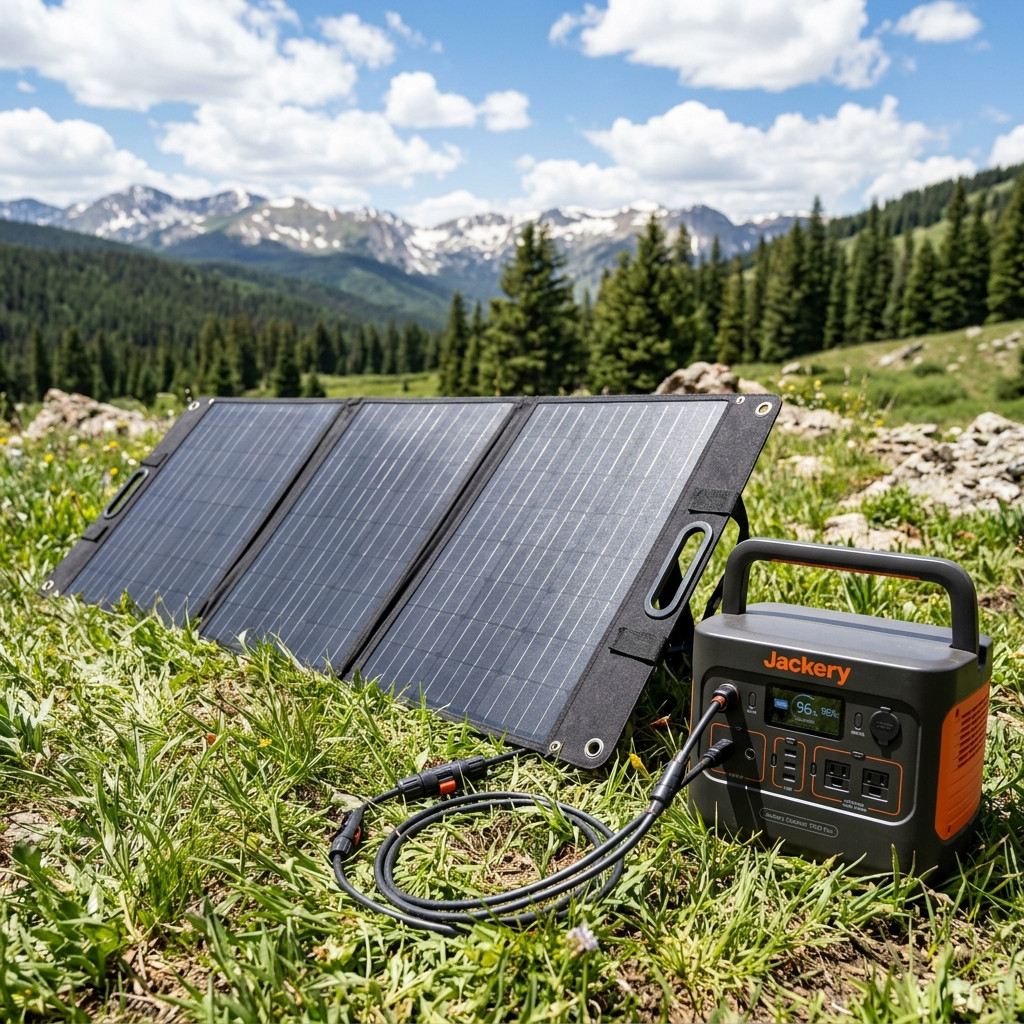
The Jackery SolarSaga 100W is widely recognized for its sleek design and ease of use. It features a built-in carrying handle, magnetic closures, and two integrated kickstands that snap out in seconds. The ETFE-laminated case provides decent weather resistance and excellent light transmittance.
- Portability: 10.3 lbs (4.67 kg) | Folded Dimensions: 24 x 21 x 1.4 inches
- Wattage: 100 Watts (Monocrystalline)
- Price Tier: High ($$$)
- What is NOT Included: This panel is designed primarily for portable solar generators. It does not include standard MC4 output cables or an inline charge controller for traditional 12V house batteries. You will need special adapters to connect it to standard battery terminals.
If your off-grid living setup relies on pre-built portable power stations rather than a custom-wired battery bank, this is the most seamless, plug-and-play panel you can buy.
4. Dokio 220W Foldable Solar Panel (Best Budget per Watt)
For those looking to maximize their solar capacity on a tight budget, the Dokio 220W panel is a popular choice. It utilizes a fabric-backed folding book design that packs flat. Despite its high wattage rating, it remains incredibly thin and lightweight.
- Portability: 10.5 lbs (4.8 kg) | Folded Dimensions: 21.2 x 28.7 x 0.9 inches
- Wattage: 220 Watts (Monocrystalline)
- Price Tier: Low ($)
- What is NOT Included: While it comes with a basic PWM charge controller, the controller is not waterproof and is highly inefficient compared to modern MPPT controllers. Heavy-duty mounting stands are also omitted.
This panel is perfect for budget-conscious off-grid dwellers who are willing to supply their own high-quality charge controller and DIY some simple prop rods to keep the panel angled toward the sun.
5. Bluetti PV200 200W Solar Panel (Best Premium Build)
The Bluetti PV200 is engineered for high performance even in partial shade conditions, thanks to its smart cell layout. It features durable ETFE coating, which resists scratches and handles heat better than cheaper PET-coated panels. The kickstands offer multiple angle adjustments (35°, 45°, and 55°).
- Portability: 16.1 lbs (7.3 kg) | Folded Dimensions: 23.2 x 24.8 inches
- Wattage: 200 Watts (Monocrystalline)
- Price Tier: High ($$$)
- What is NOT Included: No charge controller is included. The integrated MC4 cables are relatively short (around 9 feet), meaning you will need to purchase extension cables to achieve true shade flexibility.
This panel is highly recommended for users who have invested in high-end lithium iron phosphate (LiFePO4) battery banks and want a premium, long-lasting solar collector to match their system's longevity.
What is NOT Included: The Hidden Costs of Portable Solar
One of the most common mistakes off-grid buyers make is assuming a portable solar panel is a complete, ready-to-run system out of the box. In almost all cases, manufacturers sell the panels as standalone collectors. To avoid frustration during your first off-grid trip, prepare for these necessary additions:
1. Solar Charge Controller
A solar panel produces raw, unregulated DC voltage (often between 18V and 24V for a nominal 12V panel). If you connect this directly to your 12V house batteries, you will ruin them. You must route the power through a charge controller (either PWM or MPPT) to safely regulate the voltage and current.
2. Extension Cables (The "Shade Escape" Cord)
Most portable panels include cables that are only 3 to 9 feet long. To park your living space in the shade and place your panels in the sun, you will need a 20-foot or 30-foot extension cable. Look for heavy-duty 10 AWG (American Wire Gauge) solar extension cables to minimize voltage drop over the distance.
3. Adapter Plugs
Different solar setups use different connection ports. While most professional panels use standard MC4 connectors, your mobile home might have a "Solar Ready" port that uses an SAE, Anderson Powerpole, or coaxial input. You will need to purchase the correct adapter to bridge your panel's output to your dwelling's input port.
Comparing Portable Solar Form Factors
Before purchasing, it is helpful to compare the two main design styles of portable panels: hard-sided suitcases and folding fabric panels. Each has distinct advantages depending on your storage capacity and weather exposure.
| Feature | Hard-Sided Suitcase | Folding Fabric Panel |
|---|---|---|
| Durability | High (Tempered glass, aluminum frame) | Moderate (Fabric can wear, PET/ETFE face) |
| Weight | Heavy (Typically 20-30 lbs) | Lightweight (Typically 8-16 lbs) |
| Weatherproofing | Excellent (Can be left out in heavy rain) | Moderate (Should be packed away during storms) |
| Storage Footprint | Thicker, rigid profile | Ultra-thin, highly compactable |
How to Integrate Portable Panels with an Existing System
If you already have solar panels mounted on your roof, adding a portable panel requires some planning. You cannot simply splice a portable panel directly into your existing roof-mounted solar array's wiring unless they have identical electrical characteristics (voltage and amperage).
The safest and most efficient way to add a portable panel to an existing system is to give the portable panel its own dedicated, inexpensive charge controller. You can wire this secondary charge controller directly to your main battery bank. Both the roof-mounted controller and the portable controller will work together in harmony to charge the same battery bank without interfering with one another.
Summary of the Best Portable Solar Panels
Choosing the right portable solar panel depends heavily on your storage limits, physical strength, and budget. If you want a set-and-forget panel that can withstand high winds and heavy downpours, the Renogy 100W Suitcase is a phenomenal, rugged choice. If saving weight and space is your primary goal, the BougeRV 200W or the Jackery SolarSaga 100W will serve your mobile lifestyle beautifully.
Always remember to budget for the necessary extension cables and adapters so you can position your new solar collectors exactly where the sun shines brightest, keeping your off-grid living space cool, comfortable, and fully powered.
Frequently Asked Questions
Can I leave portable solar panels out in the rain?
It depends on the design. Hard-sided suitcases with tempered glass and aluminum frames (like the Renogy Suitcase) are fully waterproof and can handle heavy rain. Fabric-backed folding panels (like the Dokio or Jackery models) are water-resistant but should not be left out in prolonged downpours, as water can eventually seep into the canvas backing and degrade the wiring.
How long of an extension cable can I use with portable panels?
You can safely run up to 30 or 40 feet of cable, but you must use a thick enough wire gauge to prevent power loss. For runs up to 30 feet, a 10 AWG solar extension cable is highly recommended. If you go beyond 40 feet, you should step up to an 8 AWG cable to minimize voltage drop.
Do portable solar panels come with a charge controller?
Some models are sold as "kits" that include a basic charge controller, but many are sold as standalone panels. Always check the product description carefully. If a panel does not include a controller, you must purchase a separate PWM or MPPT charge controller to safely charge your 12V or 24V battery bank.
Can I mix a portable panel with my roof solar panels?
Yes, but it is highly recommended to run the portable panel on its own separate charge controller. Connecting a portable panel directly in series or parallel with your roof panels can severely limit the system's overall output if the panels do not have matching voltage and amperage ratings.