
Key Takeaways for Weekend Solar Sizing
- The Starter Sweet Spot: A 200W solar panel array combined with a 100Ah battery is the standard configuration for short, two-night off-grid trips.
- Battery Chemistry Matters: A 100Ah Lithium (LiFePO4) battery offers 1,280 watt-hours of usable energy, whereas a 100Ah Lead-Acid battery only safely provides 600 watt-hours.
- Load Management is Crucial: This setup easily powers basic DC loads like LED lights, water pumps, fans, and device chargers, but struggles with heavy AC appliances.
- The Backup Plan: Always start your weekend trip with your battery bank charged to 100% from home or shore power to minimize reliance on real-time solar generation.
Escaping the noise of crowded campgrounds for a quiet weekend off-grid is one of the greatest pleasures of owning a mobile living space. However, the peace of a remote campsite can quickly fade if your lights flicker out on your first night. Properly sizing your electrical system for a short getaway prevents these unexpected power shortages.
Unlike full-time off-grid living, weekend trips do not require massive, expensive solar arrays. You only need enough stored energy and supplementary solar generation to bridge a 48-hour gap. By understanding your specific power needs, you can design a highly efficient system without overspending on unnecessary equipment.
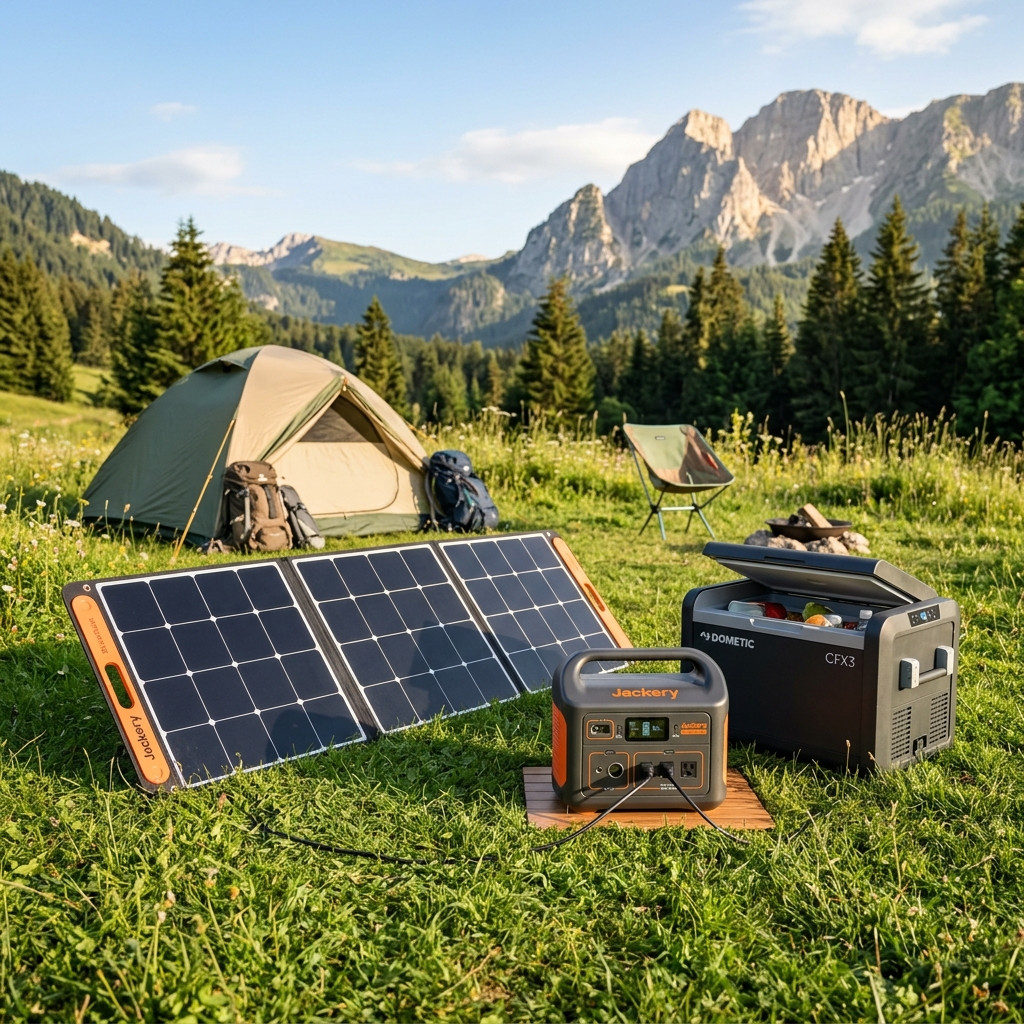
This guide analyzes a classic weekend setup: a 200-watt solar array paired with a single 100-amp-hour battery. We will break down the math, simulate a two-night trip, and determine exactly what this system can run. With a clear plan, you can head into the wilderness confident that your off-grid dwelling will remain fully powered.
Calculate Your Off-Grid Daily Balance:
Match your daily appliance watt-hours against solar harvesting. Tally appliance loads with the RV Daily Power Calculator, and model your net battery autonomy with the Daily Solar Power Balance Calculator.
The Physics of Weekend Off-Grid Power
To determine if a solar setup will last through the weekend, we must look at energy as a finite budget. Your battery serves as your checking account, holding a specific amount of stored energy. Your solar panels act as daily deposits, while your lights, fans, and water pump represent daily withdrawals.
For a short two-night trip, your starting balance is highly predictable. You typically depart from home with a battery bank charged to 100% via shore power. This means your solar panels do not have to generate all your energy from scratch; they simply need to replenish what you consume during the day.
To avoid running out of power, it is crucial to understand how to calculate your RV's daily watt-hour usage before setting off. Balancing your daily consumption against your battery capacity and solar generation ensures you never face a dead battery in the middle of the night.
Deconstructing the 100Ah Battery Bank
The foundation of any weekend solar system is the battery bank. While a 100-amp-hour (Ah) battery is the most common entry-level size, its actual usable capacity depends heavily on its internal chemistry. The two primary choices are traditional Lead-Acid (including AGM) and Lithium Iron Phosphate (LiFePO4).
Lead-acid batteries should not be discharged past 50% of their total capacity to prevent permanent damage. Therefore, a 100Ah lead-acid battery only provides 50Ah of usable power, equivalent to roughly 600 watt-hours (Wh) at a nominal 12 volts. This limitation significantly restricts your energy budget over a 48-hour period.
In contrast, a 100Ah lithium battery can safely be discharged to 100% of its capacity, providing the full 100Ah of usable power. At a standard nominal voltage of 12.8V, this translates to 1,280 watt-hours of usable energy. Lithium also maintains a stable voltage throughout its discharge cycle, ensuring your appliances run efficiently.
Evaluating the 200W Solar Panel Array
A 200W solar array typically consists of either two 100W panels wired together or a single 200W panel. In perfect laboratory conditions, this array produces 200 watts of electrical power per hour. However, real-world conditions like atmospheric dust, panel temperature, and sun angle reduce this output.
To estimate daily production, we use "peak sun hours," which represents the equivalent duration of maximum sunlight intensity in a day. On a clear day in late spring or summer, most of North America receives between 4 and 5 peak sun hours. This serves as the basis for calculating your daily solar harvest.
Applying a standard 75% system efficiency factor accounts for losses in the charge controller, wiring, and panel angle. Under clear skies with 4.5 peak sun hours, a 200W system will generate approximately 675 watt-hours of energy per day (200W x 4.5 hours x 0.75 efficiency). This daily deposit is key to extending your weekend stay.
Establishing a Realistic Weekend Load Profile
To see if this system works, we must outline a realistic "load profile" for a weekend warrior. This scenario assumes a comfortable but mindful style of camping. We will avoid heavy heating or cooling appliances, focusing instead on the essential comforts of a small off-grid dwelling.
Our typical weekend load profile includes running efficient LED interior lighting, operating the 12V water pump for quick showers and dishwashing, charging two smartphones and a tablet, running a 12V rooftop ventilation fan overnight, and powering a small, highly efficient 12V compressor refrigerator.
| Appliance / Load | Power Draw (Watts) | Daily Run Time (Hours) | Daily Energy Used (Wh) |
|---|---|---|---|
| LED Interior Lights (x4) | 16W (4W each) | 4.0 hours | 64 Wh |
| 12V Water Pump | 60W | 0.25 hours (15 mins) | 15 Wh |
| Smartphones (x2) | 10W each | 2.0 hours (charging) | 40 Wh |
| Tablet / E-Reader | 15W | 2.0 hours (charging) | 30 Wh |
| 12V Rooftop Vent Fan | 15W (on medium speed) | 8.0 hours | 120 Wh |
| 12V Compressor Fridge | 40W (running ~35% of time) | 24.0 hours | 336 Wh |
| Total Daily Energy Consumption | 605 Wh | ||
Our total daily demand comes out to 605 watt-hours. This baseline represents a highly common, realistic usage pattern for campers who want modern conveniences without going overboard. Understanding the difference between 12V vs 120V in an RV will help you decide which appliances are safe to run directly from your battery bank without incurring heavy inverter losses.
The Weekend Simulation: Will It Work?
Now, let us simulate a standard 48-hour weekend getaway, starting on Friday at 4:00 PM and ending on Sunday at 4:00 PM. We will test this load profile against both a 100Ah Lithium battery and a 100Ah Lead-Acid battery, with a 200W solar array harvesting 675 Wh on Saturday.
Scenario A: The 100Ah Lithium Battery Setup
Friday Night (4:00 PM to Saturday 8:00 AM): You arrive at your campsite with your lithium battery fully charged to 100% (1,280 Wh). Over the evening and night, you run your lights, water pump, fan, charge your devices, and keep the fridge cold. This consumes roughly 350 Wh of energy. By Saturday morning, your battery sits at 930 Wh (approx. 73% capacity).
Saturday Day (8:00 AM to 4:00 PM): During the day, your fridge keeps running, and you use a small amount of water. This daytime consumption is about 255 Wh. Meanwhile, your 200W solar panels catch the sun, generating 675 Wh of clean energy. The net gain of 420 Wh (675 Wh generated minus 255 Wh consumed) pushes your battery back up to its maximum capacity of 1,280 Wh by late afternoon.
Saturday Night to Sunday Departure: You repeat the cycle, consuming another 350 Wh overnight. On Sunday morning, you have 930 Wh remaining. Even with moderate solar generation on Sunday before you pack up, you will head home with more than enough power to spare. The lithium setup handles this weekend trip with ease.
Scenario B: The 100Ah Lead-Acid (AGM) Battery Setup
Friday Night: You arrive with a fully charged lead-acid battery, but you only have 600 Wh of usable energy before hitting the critical 50% depth of discharge limit. After consuming 350 Wh overnight, your battery is left with only 250 Wh of usable energy (putting the battery at roughly 70% total state of charge, or 30% of its usable range).
Saturday Day: Your daytime consumption of 255 Wh nearly matches the remaining usable energy in your battery. Fortunately, the sun comes out, and your 200W panels generate 675 Wh. This solar input is enough to fully replenish the battery back to 100% by the end of the day, saving you from over-discharging the cells.
The Verdict on Lead-Acid: While the lead-acid system works under sunny conditions, it leaves very little room for error. If Saturday is completely cloudy or rainy, your solar panels might only generate 150 Wh. In that case, you would deplete your battery past the safe 50% threshold by Saturday evening, risking permanent damage to your battery bank.
The Hidden Power Thief: Inverter Efficiency
Our weekend simulation assumes that all your appliances run natively on 12-volt Direct Current (DC) power. This includes your lights, ventilation fan, and USB device chargers. Running appliances directly on DC is highly efficient because it avoids the need to convert power to 120-volt Alternating Current (AC).
If you plan to use household appliances like a standard coffee maker, microwave, or residential television, you must use an inverter. Inverters convert 12V DC battery power into 120V AC power. However, this conversion process is not perfectly efficient, typically losing 10% to 15% of the energy as heat.
Furthermore, an inverter draws a small amount of "idle power" simply by being turned on, even if nothing is plugged into it. This idle draw can easily pull 1 to 2 amps per hour, draining up to 240 watt-hours a day. For a weekend trip on a tight energy budget, keeping the inverter turned off whenever possible is vital.
What if the Weather Turns Bad?
A perfect weekend trip can quickly be interrupted by a sudden storm or persistent overcast skies. Heavy cloud cover can reduce your solar panel output by 50% to 90%. Under a thick layer of storm clouds, your 200W array might only produce 60 to 100 watt-hours of energy over the entire day.
In this scenario, your battery chemistry becomes your primary safety net. A lithium battery, with its 1,280 Wh capacity, can easily carry your 605 Wh daily load for two full days without receiving any solar charge. This makes lithium batteries highly resilient against poor weather.
With a lead-acid battery, a cloudy Saturday means you will likely run out of usable power by Saturday night. To survive a rainy weekend with lead-acid, you must practice strict energy conservation. This means turning off your 12V fridge and using an ice-filled cooler instead, or keeping device charging to an absolute minimum.
Simple Strategies to Maximize Weekend Solar
If you want to ensure your 200W solar and 100Ah battery setup performs flawlessly, a few simple operational adjustments can make a significant difference. These practices require no extra equipment but greatly improve your overall system efficiency.
- Pre-Cool Your Refrigerator: Turn on your 12V refrigerator and load it with cold food 24 hours before you leave, while your RV is still plugged into home shore power. This prevents your battery from having to work hard to cool down a warm fridge on your first night.
- Use Portable Solar Panels: If your panels are not permanently mounted to your roof, use a portable solar suitcase. This allows you to park your living space in the shade while placing your panels in direct sunlight, maximizing their daily output.
- Tilt Your Panels: Flat-mounted rooftop panels lose significant efficiency when the sun is low in the sky, especially in the spring and autumn. Tilting your panels directly toward the sun can increase your daily solar harvest by up to 30%.
- Charge Devices During the Day: Charge your phones, tablets, and laptops during the middle of the day when your solar panels are producing excess power. This direct use of solar energy prevents unnecessary wear on your battery bank at night.
Comparing System Upgrades: Panels vs. Batteries
If you complete a few weekend trips and find that your power budget is too tight, you may want to expand your system. The question then becomes whether to add more solar panels or increase your battery capacity. The answer depends on your primary bottleneck.
If you find that your battery is fully charged by noon every day but you still run out of power late at night, your battery bank is too small. In this case, upgrading from a 100Ah battery to a 200Ah battery bank will allow you to store more of the abundant daytime solar energy for nighttime use.
On the other hand, if your battery rarely returns to a 100% state of charge by the end of a sunny day, your solar array is too small to keep up with your daily consumption. Adding another 100W or 200W solar panel will increase your daily charging rate, ensuring your battery bank gets fully replenished.
Summary of the Weekend Sizing Verdict
For the vast majority of weekend campers, a 200W solar array paired with a 100Ah lithium battery is an exceptionally balanced and capable system. It provides complete energy independence for a standard two-night trip without requiring heavy, expensive, or complex equipment installations.
By keeping your energy demands modest, prioritizing 12V DC appliances, and starting your trip with a fully charged battery, you can enjoy all the comforts of home in a remote setting. This simple, reliable setup allows you to focus on the outdoor experience rather than worrying about your power levels.
Frequently Asked Questions
Can I run a microwave with a 200W solar and 100Ah battery setup?
No, running a microwave is not practical with this system. A standard microwave requires between 1,000 and 1,500 watts of AC power, which requires a large inverter. Running a microwave for just 10 minutes would consume roughly 150 to 250 watt-hours, which represents a massive drain on a single 100Ah battery bank.
Is a charge controller necessary for a 200W solar system?
Yes, a charge controller is absolutely necessary. Solar panels can output voltages exceeding 20 volts, which would quickly damage a 12-volt battery if connected directly. The charge controller regulates the incoming voltage and current from the panels, ensuring your battery charges safely and efficiently without overcharging.
How long will it take to charge a 100Ah battery with 200W of solar?
In ideal sunny conditions, a 200W solar array producing roughly 12 to 14 amps of current will take about 7 to 9 hours of direct sunlight to fully charge a completely discharged 100Ah lithium battery. For a lead-acid battery, the charging process takes longer due to the slower absorption phase required by lead-acid chemistry.
Can I run an air conditioner with this weekend setup?
No, a standard RV air conditioner requires far more power than a 200W solar array and a 100Ah battery can provide. Even a small, highly efficient 12V air conditioner draws 30 to 50 amps per hour, which would completely drain a 100Ah lithium battery in less than two hours of continuous operation.