
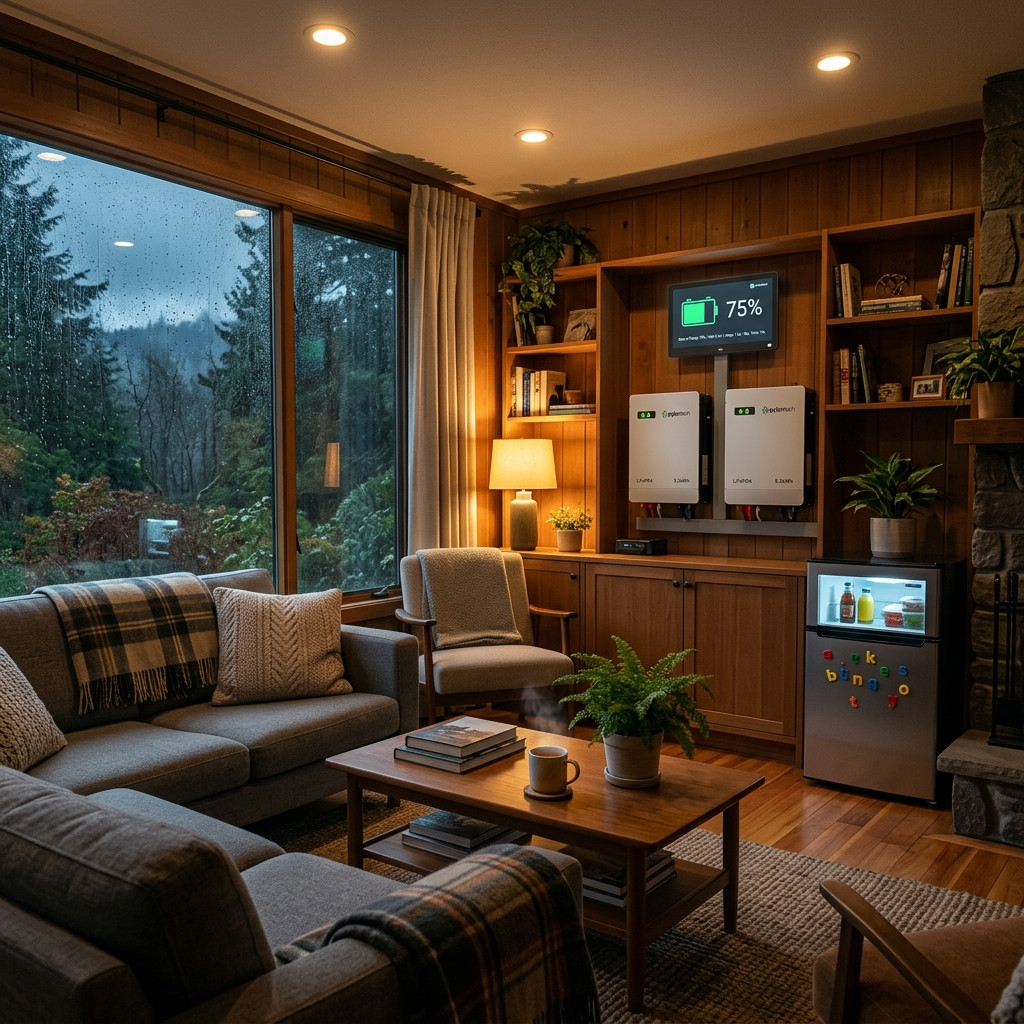
Living off the grid in a mobile dwelling or remote cabin brings an incredible sense of freedom. However, that independence relies entirely on your electrical system. When you disconnect from shore power and do not have solar panels harvesting sunlight, your home-on-wheels runs on a strictly limited supply of stored energy.
For many off-grid enthusiasts, the critical question is simple: how many days can a battery bank actually last on its own? The short answer is that a standard battery setup typically lasts between 1 to 3 days under moderate use. However, the true duration depends heavily on your battery chemistry, capacity, and daily electrical demands.
To plan your off-grid stays without running out of power, you need to understand how your battery stores energy and how your appliances consume it. This guide breaks down the math, offers real-world scenarios, and explains how to stretch your power reserve as far as possible.
Key Takeaways
- Standard Runtimes: A single 100Ah lead-acid battery typically lasts 12 to 24 hours, while a 100Ah lithium battery can easily power basic needs for 2 to 3 days.
- Depth of Discharge (DoD): Lead-acid batteries should only be discharged to 50%, whereas lithium (LiFePO4) batteries allow you to safely use up to 100% of their rated capacity.
- Solar and Generators: Solar panels act as a daily replenishment system to extend off-grid stays indefinitely, while a generator serves as a reliable rapid-charging backup.
- Power Management: Eliminating phantom loads and turning off your inverter when it is not needed are the easiest ways to double your battery runtime.
Decode Your True Battery State of Charge:
LiFePO4 voltage curves are deceptive. Use our Battery SoC & Voltage Interpreter to read exact capacity from resting voltage, or tune your charge profile using the LiFePO4 Controller Settings Finder.
The Core Math of Battery Autonomy
To determine how long your dwelling can run without a charge source, you must look at the numbers. Battery capacity is measured in Amp-Hours (Ah), which represents the amount of current a battery can deliver over a specific period. To calculate the total energy available, you multiply the Amp-Hours by the system voltage to get Watt-Hours (Wh).
For example, a standard 12-volt, 100Ah battery has a total theoretical capacity of 1,200 Watt-Hours (12V x 100Ah = 1,200Wh). However, the amount of this energy you can actually use depends entirely on the battery chemistry you install in your living space.
Understanding these electrical units is the first step toward masterfully managing your off-grid power. For a deeper look into these concepts, check out our guide on RV solar terminology explained to master watts, amps, and volts.
Lead-Acid vs. Lithium Usable Capacity
Traditional lead-acid batteries, including flooded, Gel, and AGM types, have a strict physical limitation. You should never discharge them past 50% of their total capacity. Discharging them further causes permanent chemical damage and severely shortens their lifespan. Therefore, a 100Ah lead-acid battery only offers 50Ah of usable power.
Lithium Iron Phosphate (LiFePO4) batteries have revolutionized off-grid living. They can safely be discharged to 100% of their capacity without damaging the cells. This means a 100Ah lithium battery provides a full 100Ah of usable power, effectively doubling your available run time in the exact same physical footprint.
The Role of System Voltage
Your system voltage also dictates how efficiently your appliances draw power. Most small cabins and mobile dwellings operate on a 12V DC system for lighting and basic pumps, but rely on an inverter to convert that power to 120V AC for household electronics.
When planning your battery bank, knowing what your battery can actually run on 12V versus 120V systems is crucial. Inverters lose roughly 10% to 15% of their energy simply performing this conversion, which drains your battery bank much faster than running native DC appliances.
Battery-Only Scenarios: Real-World Runtimes
To make these numbers practical, let us look at how different battery configurations perform under realistic daily usage. We will assume a modest off-grid dwelling consumption of roughly 1,000 Watt-Hours (or about 83 Amp-Hours at 12V) per day. This covers basic lighting, running a water pump, charging two phones, and operating a high-efficiency 12V refrigerator.
Scenario A: Single 100Ah Lead-Acid Battery
A single 100Ah lead-acid battery gives you 50Ah of usable power, which equates to 600 Watt-Hours. If your daily consumption is 1,000Wh, this battery will drain to its safe limit in approximately 14 hours. It cannot even get you through a single full day without needing a charge.
Scenario B: Dual 100Ah Lead-Acid Batteries (200Ah Total)
With two lead-acid batteries wired in parallel, you have a total of 200Ah, giving you 100Ah of usable capacity (1,200 Watt-Hours). Under the same 1,000Wh daily load, this setup will last about 1.2 days. You can survive a single night and a lazy morning, but you will need to recharge by the next afternoon.
Scenario C: Single 100Ah Lithium (LiFePO4) Battery
A single 100Ah lithium battery provides 100Ah of fully usable capacity (1,200 Watt-Hours). Because you can drain it completely without damage, it easily covers your 1,000Wh daily load for 1.2 days. It matches the performance of two heavy lead-acid batteries while weighing a fraction of the amount.
Scenario D: Dual 100Ah Lithium Batteries (200Ah Total)
A 200Ah lithium bank delivers a massive 2,400 Watt-Hours of usable energy. At a daily consumption rate of 1,000Wh, this system will power your off-grid dwelling for nearly 2.5 days without a single drop of solar or generator input. This is the sweet spot for weekend off-grid trips.
Estimated Battery Runtime Comparison Table
The table below outlines how long different battery banks will last based on three distinct levels of daily energy consumption. Minimal use represents basic lighting and device charging. Moderate use includes a 12V fridge and light fan use. Heavy use includes frequent inverter use for appliances like coffee makers or blenders.
| Battery Bank Setup | Usable Energy (Wh) | Minimal Use (500 Wh/day) | Moderate Use (1,200 Wh/day) | Heavy Use (2,500 Wh/day) |
|---|---|---|---|---|
| 1x 100Ah Lead-Acid | 600 Wh | 1.2 Days | 0.5 Days (12 Hours) | 0.2 Days (5 Hours) |
| 2x 100Ah Lead-Acid | 1,200 Wh | 2.4 Days | 1.0 Day | 0.5 Days (12 Hours) |
| 1x 100Ah Lithium | 1,200 Wh | 2.4 Days | 1.0 Day | 0.5 Days (12 Hours) |
| 2x 100Ah Lithium | 2,400 Wh | 4.8 Days | 2.0 Days | 1.0 Day |
| 4x 100Ah Lithium | 4,800 Wh | 9.6 Days | 4.0 Days | 1.9 Days |
What Are You Running? The Power Draw Factor
Your physical battery bank is only one half of the equation. The other half is your daily energy consumption. Estimating your consumption prevents you from accidentally draining your batteries in the middle of the night.
If you are unsure how much energy your appliances consume, it is highly recommended to calculate your requirements. Reading about how much electricity an off-grid home or RV uses per day will help you build a highly accurate daily power budget.
The Constant Drains (Phantom Loads)
Many off-grid dwellers forget about standby power. Devices like carbon monoxide detectors, stereo displays, thermostat backlights, and the standby mode on your television constantly sip power. Individually, they may only draw 0.1 to 0.5 Amps, but collectively they can drain up to 15 to 20 Amp-Hours per day without you ever turning on a single appliance.
High-Wattage Heating Appliances
Any appliance that creates heat using electricity is a battery killer. This includes hair dryers, space heaters, electric kettles, microwaves, and coffee makers. Running a 1,500W microwave for just 10 minutes consumes 250 Watt-Hours of energy. Doing this a few times a day will quickly deplete a small battery bank.
Why Solar is the Ultimate Game Changer
Relying solely on a battery bank means you are operating on a depleting asset. Every light you turn on brings you one step closer to total darkness. This is why solar panels are so transformative for off-grid living spaces.
Solar panels act as a continuous, automatic replenishment system. During the day, even a modest solar array can generate enough energy to power your active loads while simultaneously pushing surplus power back into your battery bank. This cycle allows you to extend your off-grid stay indefinitely, limited only by your water supply and waste tank capacities.
With a properly sized solar setup, your batteries transition from being your primary energy source to acting as a temporary storage buffer for nighttime and cloudy days. You no longer have to worry about counting every single amp-hour consumed during the day.
The Essential Role of a Generator Backup
While solar is clean and silent, it depends entirely on the weather. If you experience three consecutive days of heavy rain, thick cloud cover, or deep forest shade, your solar panels will produce very little power. In these situations, a backup generator is your safety net.
A generator can bulk-charge your battery bank in a matter of hours, restoring your system to full capacity when solar is unavailable. It also allows you to run high-draw appliances like air conditioners or electric heaters directly, without draining your precious battery reserve.
When designing your off-grid system, balancing these two power sources is key. Weighing the pros and cons in the RV solar vs generator comparison can help you decide how to balance silent solar harvesting with the reliable raw power of a backup generator.
How to Stretch Your Battery Life Without Solar
If you find yourself off-grid without solar or a generator, conservation becomes your primary goal. Fortunately, a few simple adjustments to your daily habits can easily double your battery bank's runtime.
1. Turn Off Your Inverter
An inverter converts 12V DC battery power into 120V AC household power. Even when you are not actively using any 120V appliances, an active inverter consumes roughly 1 to 2 Amps of standby current just staying turned on. Switching your inverter off when you do not need to power AC devices saves massive amounts of energy over a 24-hour period.
2. Swap to Efficient LED Lighting
Incandescent bulbs are highly inefficient, converting most of their energy into heat. Replacing them with modern LED bulbs reduces your lighting power consumption by up to 80%. You can run multiple LED lights for the same energy cost as a single incandescent bulb.
3. Manage Your Refrigeration
If you have a 3-way refrigerator, run it on propane instead of 12V DC or 120V AC while boondocking. Propane is incredibly efficient for cooling and uses almost zero electrical power. If you run a 12V compressor fridge, keep it full of cold items to help it retain its temperature, and avoid holding the door open for long periods.
4. Use DC Charger Ports Directly
Avoid using standard 120V wall blocks to charge your phones and tablets. Using a wall block forces you to turn on your inverter, which wastes energy through conversion losses. Instead, plug your devices directly into 12V USB ports, which run directly off your battery bank with minimal waste.
Frequently Asked Questions
Can I run my microwave on my battery bank without solar?
Yes, you can run a microwave if you have a sufficiently large inverter (typically 2,000 watts or higher) and a battery bank capable of handling high discharge rates. However, microwaves draw massive amounts of power. Running a microwave for just 5 to 10 minutes will consume a significant portion of a 100Ah battery, so it should be used sparingly when you do not have a charging source.
How do I know when my battery is almost dead?
For lead-acid batteries, voltage is a reliable indicator of charge status. A fully charged 12V lead-acid battery reads around 12.7V, while a reading of 12.0V indicates it has reached its 50% safe discharge limit. For lithium batteries, the voltage curve is incredibly flat, meaning they stay around 13.0V until they are nearly empty. To accurately monitor a lithium battery, you need a high-quality shunt-based battery monitor that tracks actual amp-hours in and out.
Does cold weather make my battery drain faster?
Yes, cold temperatures slow down the chemical reactions inside all battery types, temporarily reducing their effective capacity. Lead-acid batteries lose significant capacity in freezing weather. While lithium batteries perform better in the cold, they cannot be safely charged at temperatures below freezing (32°F / 0°C) without internal heating elements, though they can still be safely discharged in cold weather.
Will my battery charge while I am towing or idling?
Most tow vehicles and motorhomes feature a charge line that sends a small amount of current from the engine's alternator to the house battery. However, due to the thin gauge of standard wiring and the long distance the current must travel, this charge is typically very weak (often only 5 to 10 Amps). It is usually only enough to maintain your battery's current charge level rather than fully recharge a depleted bank.
Securing Your Off-Grid Power Independence
Operating an off-grid dwelling without solar panels or a generator is entirely possible, but it turns your battery bank into a ticking clock. If you rely on a single lead-acid battery, you will need to find a charging source daily. Upgrading to a dual-lithium battery bank can easily extend your quiet, off-grid autonomy to several days under careful usage.
Ultimately, batteries are designed to store energy, not produce it. To unlock true off-grid freedom without constantly watching your battery monitor, integrating a balanced solar array and keeping a small generator as a backup is the ultimate strategy for worry-free off-grid living.