
This post contains affiliate links — if you buy through them, we may earn a commission at no extra cost to you.
A 400W array is enough to run a compressor fridge, lighting, water pump, and basic electronics for two to three people through most boondocking days — but it will not keep up with air conditioning, electric heat, or heavy daily cooking loads. Whether 400W is "enough" depends less on the panel wattage itself and more on what's plugged into the system behind it.
Planning to Run Heavy Loads or Rooftop AC?
Don't guess compressor start surges or blow your main battery fuses. Use our interactive RV Air Conditioner Runtime Checker to calculate runtime and test surge feasibility, and size your high-amperage cables with the Inverter Fuse & Breaker Sizer.
Key Takeaways
- 400W typically produces roughly 900–1,800 watt-hours (Wh) per day depending on sun hours and system losses — not a fixed number.
- It comfortably covers fridge, lighting, water pump, and small electronics for 2–3 people in most 3-season conditions.
- It struggles or fails outright against rooftop AC, electric space heaters, and electric water heater elements — all of which draw far more than a 400W array can replace in a day.
- The battery bank paired with the array matters as much as the panel wattage — a 400W array feeding an undersized battery bank still leaves you short on usable power.
Who a 400W System Actually Suits
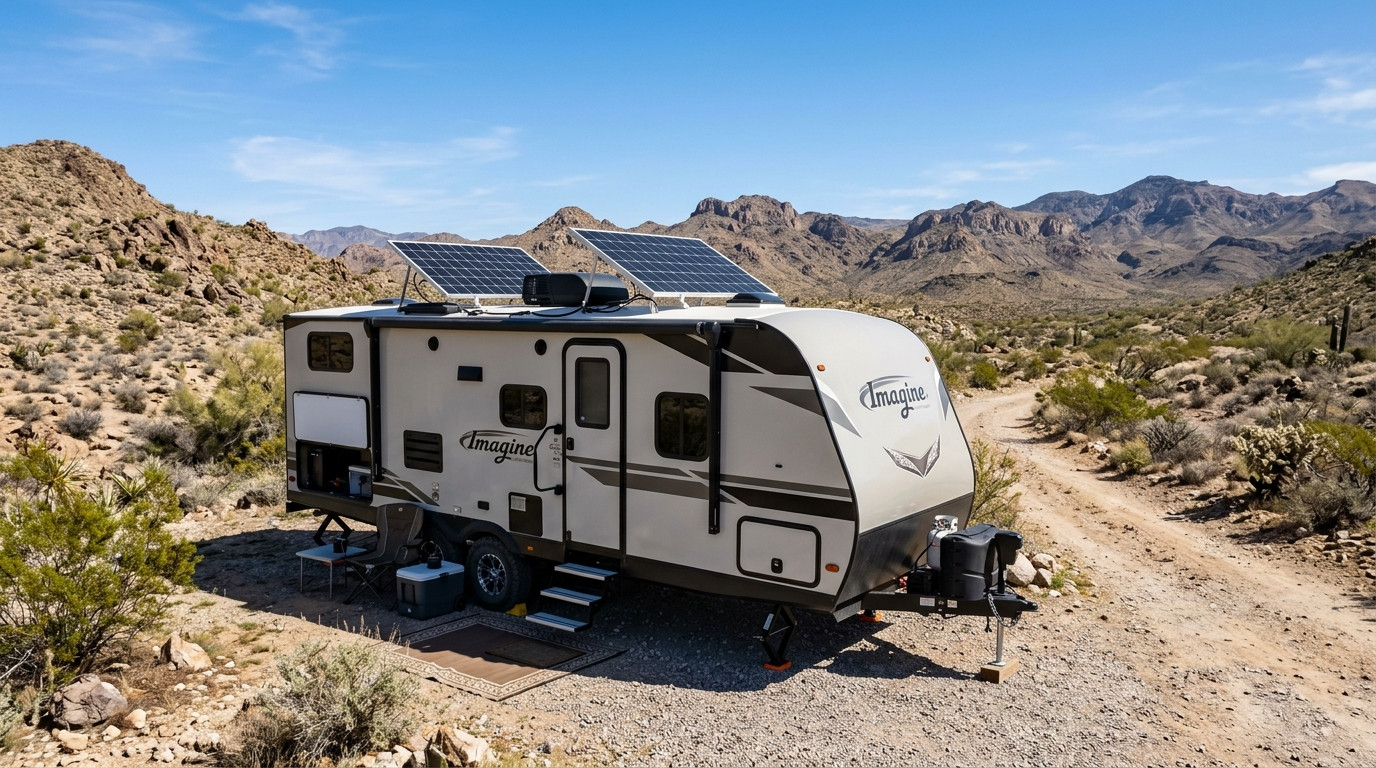
A 400W setup is a realistic match for a couple or small family — generally two to three people — traveling in a travel trailer, small fifth wheel, or camper van with a 12V compressor refrigerator, LED lighting, a water pump, and everyday electronics like phones, laptops, and a TV.
It suits people who camp in reasonably sunny conditions for at least part of the year, who don't run air conditioning off solar, and who use propane for cooking and space heating rather than electric appliances. If that description matches your setup, 400W is a genuinely workable starting point rather than an underpowered compromise.
What 400W Actually Produces in a Day
Panel wattage is a peak rating measured under lab conditions, not a daily production number. To estimate what a 400W array actually delivers, the standard approach is:
Rated watts × average daily sun hours × system efficiency factor
System efficiency accounts for panel angle, partial shading, temperature losses, charge controller inefficiency, and wiring losses — combined, these commonly reduce real-world output by roughly 20–30% compared to the panel's rated wattage. Using a 75% efficiency factor as an illustrative assumption:
| Sun Hours (per day) | Calculation | Estimated Daily Output |
|---|---|---|
| 3 hours (winter, cloudy, shaded sites) | 400W × 3h × 0.75 | ~900 Wh |
| 4.5 hours (typical 3-season average) | 400W × 4.5h × 0.75 | ~1,350 Wh |
| 6 hours (clear desert/summer sky) | 400W × 6h × 0.75 | ~1,800 Wh |
These are illustrative calculations, not guaranteed outputs — your actual sun hours depend on latitude, season, weather, and how the array is mounted. If you're comparing this to a smaller setup, the breakdown in 100W vs 200W vs 400W RV Solar: What Should You Buy? lays out how output scales as you step up panel size.
A Worked Example: Daily Energy Budget for 2–3 People
To see whether 400W keeps pace with real usage, it helps to build a basic daily load estimate. The figures below are typical ranges for common RV equipment, not manufacturer-verified numbers for any specific model — treat them as planning assumptions and check your own appliances' actual draw where possible.
| Load | Typical Draw | Estimated Daily Wh |
|---|---|---|
| 12V compressor refrigerator | ~35–50W average (cycling) | 700–1,100 Wh |
| LED interior lighting | 5–8W per fixture, 4 fixtures, 3 hrs | 60–100 Wh |
| Water pump | ~50–70W, ~20 min total | 15–25 Wh |
| Laptop + phone charging | 60W + 10W combined, ~2 hrs | 120–150 Wh |
| TV/entertainment | ~50–70W, 2 hrs | 100–140 Wh |
| Inverter idle draw (if left on) | ~5–15W, 24 hrs | 120–360 Wh |
| Estimated daily total | ~1,100–1,900 Wh |
Lined up against the production estimate above, a 400W array covers this load comfortably on a good sun day, and roughly breaks even on a mediocre one. On a genuinely poor-weather day, you're drawing down the battery bank rather than fully replacing what you used — which is normal and expected, not a sign the system is undersized, as long as sunnier days let the bank recover.
The Battery Bank Has to Match the Panels
A 400W array feeding an undersized battery bank will still leave you short on usable power, because the panels can only recharge what the batteries can actually hold and release. To use the ~1,000–1,500 Wh a 400W system typically produces, most boondockers pair it with somewhere in the range of 200–300 amp-hours of 12V lithium capacity, which stores roughly 2,400–3,600 Wh — enough to buffer a day or two of clouds without running the battery bank down to empty.
If you're still deciding how the panel size and battery capacity fit together for your specific rig, 200W RV Solar System: What Can It Actually Run? walks through the same kind of pairing math at a smaller scale, which makes the trade-offs easier to see.
Where a 400W System Falls Short
The gap between what 400W produces and what certain appliances demand isn't a matter of degree — it's a mismatch in scale. These loads are the ones that consistently overwhelm a 400W setup:
| Appliance | Typical Running Draw | Why 400W Can't Keep Up |
|---|---|---|
| Rooftop air conditioner | 1,200–1,500W running, 2,000–3,500W surge on startup | Running it for even one hour uses more than the array's entire daily production; the surge alone often exceeds what a modest inverter/battery combo can supply. |
| Electric space heater | 1,200–1,500W | A few hours of use drains the battery bank faster than the panels can ever replace it, even on a full-sun day. |
| Electric water heater element | ~1,400–1,500W | Sustained draw for water heating cycles far outpaces daily solar input; propane water heating is the practical alternative for solar-based rigs. |
| Hair dryer | ~1,200–1,500W | Short bursts are possible with a large enough inverter, but repeated daily use erodes the battery reserve quickly. |
| Microwave (heavy use) | ~900–1,200W | Occasional short use is usually fine; using it for every meal adds up to a meaningful daily load the array wasn't sized for. |
None of this means solar is the wrong choice — it means AC and electric heat are generator or shore-power tasks, not solar tasks, for a system this size. For a broader look at where solar wins and where a generator is still the better tool, RV Solar vs Generator: Which Is Better for Boondocking? covers that trade-off directly.
Weather and Season Change the Answer
The same 400W array behaves differently in July than in January. Shorter winter days, a lower sun angle, and more cloud cover in many regions can cut effective sun hours roughly in half compared to peak summer conditions. A system that comfortably covers your loads in June may need supplementing — extra panels, a generator, or reduced usage — during a winter boondocking trip further north.
Shading is the other variable that's easy to underestimate: a single tree branch shadow across part of the array during midday can reduce output far more than the shaded area alone would suggest, because of how most panel wiring is arranged. Site selection matters as much as the spec sheet.
Is 400W Enough for You? A Quick Decision Check
- Likely enough if: 2–3 people, compressor fridge, LED lighting, propane cooking and heat, occasional inverter use for laptops/small electronics, and you camp mostly in moderate-to-sunny conditions.
- Marginal if: 3–4 people with heavier device use, frequent cloudy or shaded camping, or regular microwave/entertainment-heavy days — workable, but budget for occasional shortfalls.
- Likely not enough if: you plan to run air conditioning or electric heat off solar, camp with 4+ people and full electric appliances, or need reliable power through extended winter or heavily overcast stretches.
The Practical Takeaway
400W isn't a pass/fail number — it's a mid-sized building block that matches a specific, common style of RV boondocking well and falls short of a different style entirely. The honest way to answer "is 400W enough" is to total your own daily loads against the production ranges above, rather than relying on the watt rating alone.