
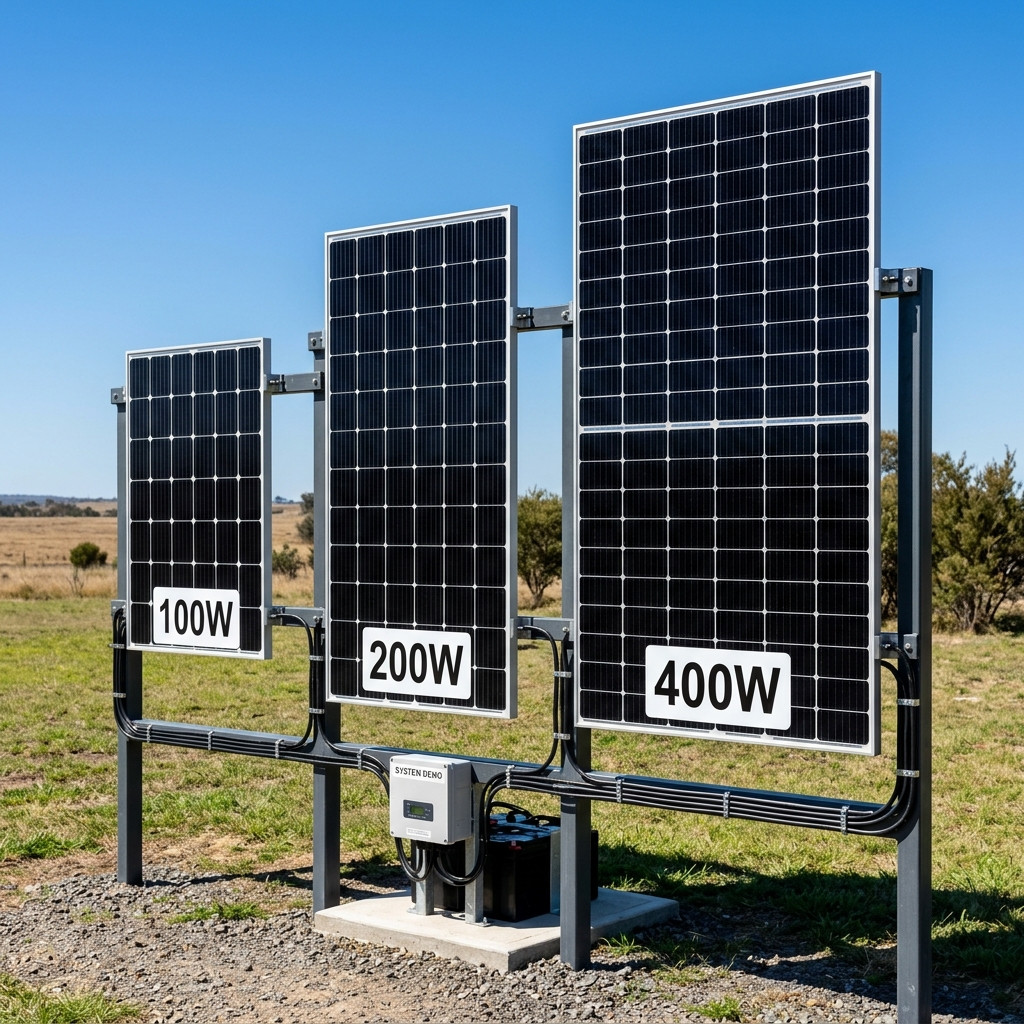
Choosing the right solar setup for your mobile living space can easily feel overwhelming. Walk through any campground, and you will see everything from tiny single panels to massive, roof-spanning arrays. Deciding between a 100-watt, 200-watt, or 400-watt system is one of the most critical decisions you will make when designing your off-grid electrical setup.
This post contains affiliate links — if you buy through them, we may earn a commission at no extra cost to you.
The right choice depends entirely on how you travel, what appliances you need to power, and the physical limits of your roof. A system that is too small leaves you in the dark, while an oversized system wastes money and valuable roof real estate. Let's break down these three common capacities to help you find the perfect fit for your power needs.
Key Takeaways
- 100W Solar: Best for battery maintenance, light weekend trips, and powering basic DC loads like LED lights and water pumps.
- 200W Solar: The ideal starting point for casual off-grid camping, keeping a single 100Ah lithium battery charged under moderate use.
- 400W Solar: The sweet spot for serious boondockers who want to run residential-style appliances, charge laptops, and use an inverter daily.
- Roof Space Matters: Always measure your roof's flat areas, accounting for vents, AC units, and shadows, before purchasing hardware.
Understanding Solar Panel Wattage in the Real World
Before comparing sizes, it helps to understand what a watt rating actually means for your daily power supply. A solar panel's wattage rating indicates its maximum power output under perfect laboratory conditions. In the real world, weather, dust, angle, and seasonal sunlight will reduce this peak output.
To estimate your daily energy production, you must calculate peak sun hours. On average, most regions in North America receive between 4 and 5 hours of usable, direct sunlight per day. To find out more about how these ratings translate to usable power, read our comprehensive guide on RV Solar Panels Explained: Watts, Voltage, Current and Output.
Multiplying your panel's wattage by your average sun hours gives you a realistic estimate of daily watt-hours. For example, a 100W panel in an area with 5 peak sun hours will generate roughly 500 watt-hours (Wh) of electricity per day. This simple formula forms the foundation of your entire solar planning process.
Planning to Run Heavy Loads or Rooftop AC?
Don't guess compressor start surges or blow your main battery fuses. Use our interactive RV Air Conditioner Runtime Checker to calculate runtime and test surge feasibility, and size your high-amperage cables with the Inverter Fuse & Breaker Sizer.
The 100-Watt Solar Setup: The Minimalist Entry Point
A 100-watt solar panel is the entry point for off-grid power systems. It is highly portable, inexpensive, and incredibly easy to install. For many travelers, a single 100W panel serves as a reliable battery maintainer rather than a primary power source.
What Can a 100W Panel Actually Power?
A 100W panel produces roughly 400 to 500 Wh of energy per day. This is enough to cover the baseline parasitic draws of your living space, such as LP detectors, control panels, and clocks. It will easily power high-efficiency LED ceiling lights, the water pump, and charge a couple of smartphones.
Who Is It Best For?
This setup is perfect for weekend campers who primarily stay at campgrounds with electrical hookups but want to keep their batteries topped off while in storage. It is also ideal for minimalist campers using small travel trailers or truck campers with low daily energy demands.
Physical Footprint and Installation
Physically, a standard rigid 100W panel measures roughly 40 x 20 inches and weighs around 15 pounds. Because of its compact size, it can fit on almost any roof, steering clear of vents and air conditioning shrouds. It is also the most popular size for portable, suitcase-style ground panels.
The 200-Watt Solar Setup: The Weekend Warrior Sweet Spot
For many casual campers, 200 watts of solar power represents the perfect balance of cost, physical size, and charging capability. This configuration usually consists of either one large 200W residential panel or two 100W panels wired together.
What Can a 200W Panel Setup Power?
Generating between 800 and 1,000 Wh of electricity per day, a 200W system allows you to expand your power usage. In addition to basic lighting and water pumps, you can comfortably run overhead ceiling fans, charge laptops, power a small 12V television, and run a portable 12V compressor fridge.
Who Is It Best For?
This capacity is ideal for travelers who enjoy off-grid boondocking for three to four days at a time. It provides enough power to keep a standard 100Ah lithium battery healthy without requiring constant monitoring of your energy consumption.
Physical Footprint and Installation
A typical 200W panel measures about 60 x 26 inches. If you choose to use two 100W panels instead, you gain installation flexibility. You can place them on opposite sides of your roof vents to maximize space and avoid shadows cast by larger rooftop objects.
The 400-Watt Solar Setup: The Off-Grid Standard
A 400-watt solar array is where true off-grid independence begins. This setup typically consists of four 100W panels, two 200W panels, or a pair of large residential panels. It is the gold standard for travelers who want to camp far away from shore power without compromising on modern comforts.
What Can a 400W Panel Setup Power?
With an average daily output of 1,600 to 2,000 Wh, a 400W system handles heavy daily usage. It can easily run a high-efficiency 12V refrigerator, charge multiple laptops, power a MaxxFan on high all day, and run a small 120V microwave or coffee maker through an inverter. To understand how these loads interact with your system, check out our detailed look at What Does an RV Solar System Actually Power?
Who Is It Best For?
This system is designed for full-time travelers, remote workers, and serious boondockers who spend weeks at a time on public lands. If you rely on clean, silent power daily and want to minimize your reliance on a backup generator, 400 watts is your starting point.
Physical Footprint and Installation
A 400W array requires a significant amount of flat roof space. Four 100W panels will require roughly 30 square feet of unobstructed area. You must carefully map out your roof layout to ensure none of these panels are shaded by your air conditioner or TV antenna, as even partial shade can cripple your power output.
Side-by-Side Comparison: 100W vs. 200W vs. 400W
To help visualize which option fits your needs, here is a direct comparison of the three capacities based on average real-world performance, space requirements, and hardware costs.
| Feature | 100W System | 200W System | 400W System | |
|---|---|---|---|---|
| Daily Generation (Avg) | 400 - 500 Wh | 800 - 1,000 Wh | 1,600 - 2,000 Wh | |
| Approx. Roof Space | 6 sq. ft. | 12 - 15 sq. ft. | 25 - 30 sq. ft. | |
| Ideal Battery Bank | 1x 100Ah Lead-Acid / AGM | 1x 100Ah Lithium (LiFePO4) | 2x 100Ah Lithium (200Ah total) | |
| Charge Controller | 10A PWM or MPPT | 20A MPPT | 30A - 40A MPPT | |
| Primary Use Case | Battery maintenance & lights | Light off-grid camping | Extended boondocking |
How to Match Solar Capacity to Your Travel Style
Your camping habits should dictate your solar capacity, not the other way around. If you always camp at state parks with full hookups, installing 400W of solar is an unnecessary expense. You simply will not use the power your roof is generating.
Conversely, if you love deep-woods boondocking on public lands, a 100W panel will leave you frustrated. You will find yourself constantly running a noisy generator or towing your rig back to civilization to plug in. Assess your style honestly before buying hardware.
Think about your seasonal travel plans as well. If you camp mostly in the winter or under heavy forest canopy, your panels will produce significantly less power. In these conditions, upgrading to a 400W system helps compensate for the lack of direct, intense sunlight.
The Roof Space Dilemma: Measuring Your Limits
You can buy the most advanced solar panels on the market, but if they do not fit on your roof, they are useless. RV roofs are notoriously crowded spaces. You must navigate around air conditioner units, plumbing vents, skylights, TV antennas, and roof ladders.
When planning your layout, remember that shadows are the enemy of solar efficiency. If a single corner of a panel is shaded by your air conditioner shroud, the output of the entire panel—and potentially the entire string of panels—can drop dramatically.
Before deciding on a 400W system, climb up and physically measure the flat, open areas of your roof. You may find that two 200W panels fit better than four 100W panels, or vice versa. If your roof space is extremely limited, portable ground panels might be your best alternative.
Matching Your Panels to Your Battery Bank
Solar panels do not power your living space directly; they charge your battery bank, which then runs your appliances. Therefore, your solar array and your battery capacity must be balanced. An unbalanced system leads to poor efficiency and wasted potential.
If you pair a 400W solar array with a single, small lead-acid battery, the battery will fill up too quickly, and the excess solar energy will go to waste. On the flip side, trying to charge a massive 400Ah lithium bank with a single 100W panel will take days of perfect sunlight.
A good rule of thumb is to aim for a 1:1 or 2:1 ratio of solar wattage to battery amp-hours (for 12V lithium systems). For instance, a 200W solar array pairs beautifully with a 100Ah lithium battery, while a 400W array is ideal for a 200Ah lithium setup.
Choosing the Right Charge Controller
Your choice of solar capacity also dictates the size and type of charge controller you need. The charge controller sits between your panels and your batteries, regulating the voltage and current to prevent overcharging.
For a basic 100W system, an inexpensive Pulse Width Modulation (PWM) controller is usually sufficient. However, for 200W and 400W systems, a Maximum Power Point Tracking (MPPT) controller is highly recommended. MPPT controllers are up to 30% more efficient, especially in cloudy conditions.
Ensure your charge controller can handle the total amperage of your array. A 400W array on a 12V system can produce up to 30 amps of current, requiring a robust 30A or 40A MPPT controller to safely manage the power flow.
Frequently Asked Questions
Can I start with 100W of solar and add more panels later?
Yes, you can easily expand your system later, provided you plan ahead. If you think you might upgrade, buy a larger MPPT charge controller and use thicker gauge wiring during your initial install. This prevents you from having to rewire the entire system when you add more panels.
Is 400W of solar enough to run an air conditioner?
No, 400W of solar is not enough to run a standard rooftop air conditioner. Air conditioners require massive amounts of startup and running current. To run AC off solar, you typically need at least 800W to 1200W of panels, a massive lithium battery bank, and a heavy-duty inverter.
Should I buy one 200W panel or two 100W panels?
Two 100W panels offer more physical mounting flexibility and better shade tolerance if wired in parallel. However, a single 200W panel requires fewer mounting brackets, fewer roof penetrations, and less wiring, making the physical installation process much cleaner.
Do solar panels charge my batteries on cloudy days?
Yes, solar panels can still generate electricity on cloudy days, but their output is significantly reduced. Expect your panels to produce only 10% to 25% of their rated capacity under heavy cloud cover. This is why having a larger 400W array is beneficial during poor weather.
Making Your Final Decision
Choosing between 100W, 200W, and 400W of solar comes down to a realistic assessment of your power usage and physical space. If you want simple battery maintenance and light weekend use, a 100W panel is a cost-effective, hassle-free solution.
If you want to enjoy comfortable off-grid weekends with lights, fans, and device charging, a 200W setup offers the best value. For full-time travelers, remote workers, and dedicated boondockers who want true energy independence, investing in a 400W system is the smartest path forward.