
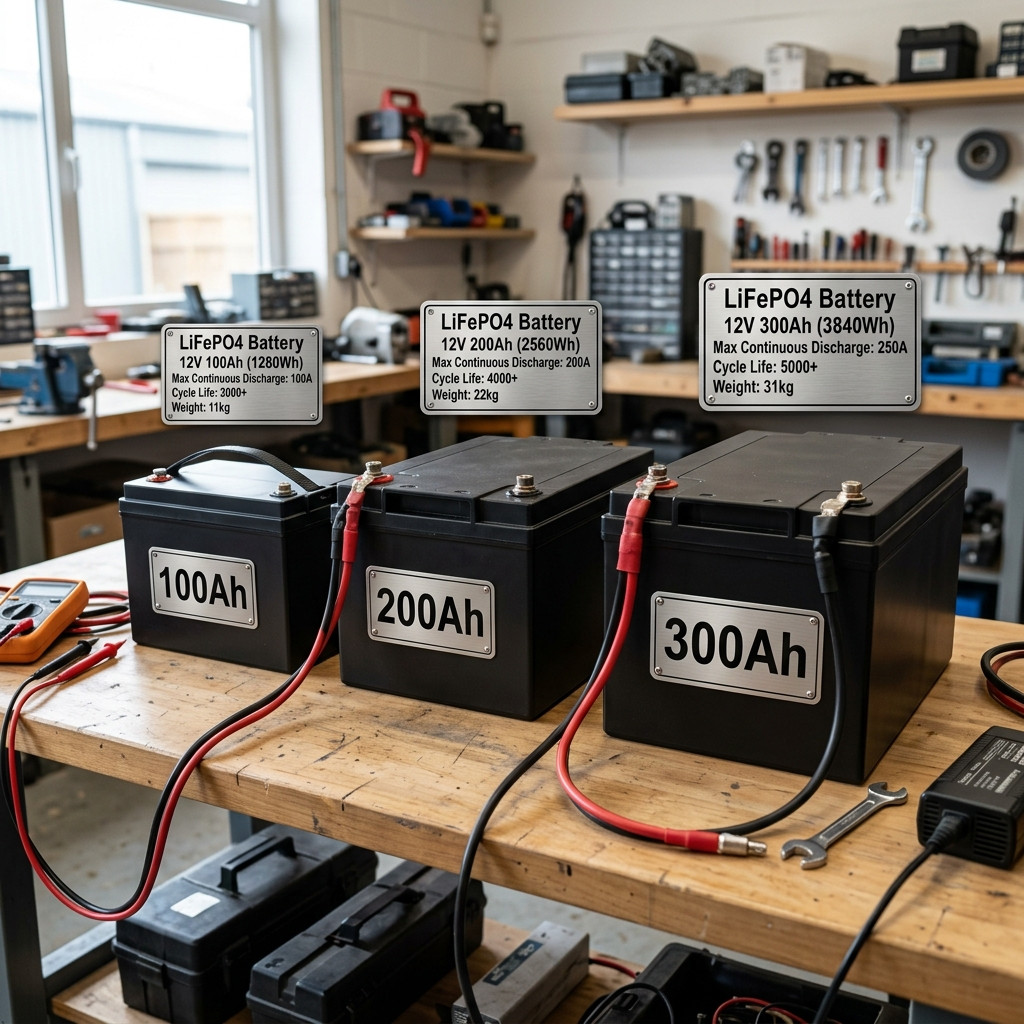
Setting up an off-grid power system for your mobile dwelling or living space is an exercise in balance. If your battery bank is too small, you will find yourself sitting in the dark by dinnertime. If it is too large, you will have spent hundreds of extra dollars on heavy capacity that you never actually use.
The choice between a 100Ah, 200Ah, or 300Ah battery is the most common decision point for anyone building a reliable solar setup. Each size serves a distinct style of off-grid living, from minimalist weekend trips to full-time residential setups. Understanding how these capacities translate into real-world appliance runtimes is the key to making the right investment.
This guide breaks down the math, compares the real-world capabilities of each battery size, and helps you choose the perfect capacity for your daily energy consumption.
- 100Ah Battery: Best for minimalist weekend trips, powering basic LED lights, water pumps, and charging mobile devices.
- 200Ah Battery: The "sweet spot" for moderate off-grid living, capable of running a 12V compressor refrigerator, laptops, and small kitchen appliances.
- 300Ah Battery: Designed for full-time off-grid living, remote work setups, and heavy-draw appliances like microwaves and coffee makers.
- Chemistry Matters: A 100Ah Lithium (LiFePO4) battery provides nearly double the usable energy of a 100Ah Lead-Acid (AGM) battery due to depth-of-discharge limits.
Decode Your True Battery State of Charge:
LiFePO4 voltage curves are deceptive. Use our Battery SoC & Voltage Interpreter to read exact capacity from resting voltage, or tune your charge profile using the LiFePO4 Controller Settings Finder.
Understanding Battery Capacity: What is an Amp-Hour?
Before comparing sizes, it is vital to understand how battery capacity is measured. An Amp-hour (Ah) indicates how much amperage a battery can deliver over the course of one hour. For example, a 100Ah battery can theoretically supply 100 Amps of current for one hour, or 5 Amps of current for 20 hours.
To make this practical for household appliances, we convert Amp-hours into Watt-hours (Wh). Watts measure the actual power consumed by your electronics. The formula is simple: multiply the battery's Amp-hours by its voltage.
For a standard 12-volt electrical system, the math looks like this:
- 100Ah Battery: 100Ah x 12V = 1,200 Watt-hours (1.2 kWh)
- 200Ah Battery: 200Ah x 12V = 2,400 Watt-hours (2.4 kWh)
- 300Ah Battery: 300Ah x 12V = 3,600 Watt-hours (3.6 kWh)
Understanding the difference between 12V vs 120V in an RV or off-grid dwelling is key to mapping out how these Watt-hours are consumed by different appliances. DC electronics run directly off the 12V system, while AC appliances require an inverter, which introduces slight power losses.
Usable Capacity: Lithium vs. Lead-Acid (AGM)
The numbers listed on a battery label do not always represent the amount of energy you can safely use. Traditional Lead-Acid and AGM batteries should never be discharged past 50% of their total capacity. Doing so permanently damages the battery cells and shortens their lifespan.
Lithium Iron Phosphate (LiFePO4) batteries, on the other hand, can safely be discharged to 80% or even 100% of their rated capacity. This means a 100Ah Lithium battery actually provides the same usable energy as a 200Ah AGM battery, while weighing a fraction of the amount.
When planning your system, always calculate your needs based on usable capacity. If you choose AGM, you must double your target battery size to avoid damaging your bank. For the remainder of this guide, we will focus on the usable capacities of modern Lithium batteries.
100Ah vs. 200Ah vs. 300Ah Comparison Chart
This comparison table shows what you can expect from each battery size in a standard 12V off-grid setup. Runtimes assume a Lithium battery chemistry with a high depth of discharge.
| Battery Capacity | Total Watt-Hours | Best Use Case | Typical Appliances Run | Est. Runtime (No Solar) |
|---|---|---|---|---|
| 100Ah (12V) | 1,200 Wh | Light weekend trips, minimalist living | LED lights, water pump, phone chargers, small fan | 1 to 2 days |
| 200Ah (12V) | 2,400 Wh | Moderate off-grid living, boondocking | 12V fridge, laptops, TV, blender, water pump | 2 to 3 days |
| 300Ah (12V) | 3,600 Wh | Full-time living, remote work, heavy appliance use | Microwave, coffee maker, Starlink, CPAP machine, fridge | 3+ days |
The 100Ah Battery: The Minimalist Entry Point
A single 100Ah lithium battery is the entry-level standard for small off-grid setups. Providing 1,200 Watt-hours of power, this capacity is designed for those who keep their electricity needs simple. It is lightweight, compact, and highly budget-friendly.
With 100Ah of capacity, you can comfortably run your essential 12V devices. This includes overhead LED lighting, the water pump for your sinks, a ceiling ventilation fan, and charging ports for your smartphones and tablets. It is the perfect size for short weekend trips where you do not need to run heavy household appliances.
However, a 100Ah battery will struggle if you introduce high-draw AC appliances. Running a 1,000-watt microwave through an inverter for just 10 minutes will consume nearly 15% of your entire battery. If you plan on using an electric refrigerator or working remotely with a laptop, a 100Ah bank will require constant daily solar recharging to keep up.
The 200Ah Battery: The Off-Grid Sweet Spot
For most off-grid living spaces and campers, a 200Ah battery bank represents the ideal balance of cost, weight, and capability. With 2,400 Watt-hours of storage, you transition from simply surviving on basic power to comfortably living with modern conveniences.
The biggest advantage of upgrading to 200Ah is the ability to run a high-efficiency 12V compressor refrigerator continuously. A typical 12V fridge consumes between 30 and 60 Amp-hours per day depending on ambient temperatures. A 200Ah bank can easily absorb this load while still leaving plenty of energy for lighting, water pumps, and electronics charging.
Additionally, 200Ah allows you to run a medium-sized inverter. You can charge laptops, run a television for a few hours, use a blender, or power a CPAP machine overnight without worrying about draining your system. It provides a comfortable safety buffer for cloudy days when your solar panels aren't producing at peak capacity.
The 300Ah Battery: The Full-Time Powerhouse
A 300Ah battery bank (delivering 3,600 Watt-hours) is designed for full-time off-grid residents, digital nomads, and those who refuse to compromise on residential comforts. This capacity allows you to run multiple high-draw appliances and support heavy daily energy usage.
If you work remotely from your off-grid dwelling, your power needs increase significantly. Running a laptop, an external monitor, and a satellite internet receiver like Starlink can easily consume 80 to 100 Watts per hour. Over an eight-hour workday, this alone can drain a smaller battery, but a 300Ah bank handles it with ease.
With 300Ah, you can also utilize high-wattage kitchen appliances. You can run a residential microwave, an electric kettle, or a coffee maker through a 2,000W or 3,000W inverter. While these appliances draw massive amounts of current, they are typically used for only a few minutes at a time, which a 300Ah lithium bank can easily sustain.
How to Calculate Your Specific Battery Needs
To avoid guesswork, you should calculate your actual daily energy consumption. This prevents you from buying too much battery or, worse, not having enough power to get through the night. To start, you must list every appliance you plan to run, its wattage, and how many hours it will operate daily.
To help you map out this process, you can learn how to calculate your daily watt-hour usage using our step-by-step sizing guide. Let's look at a quick example of a moderate off-grid day:
- 12V Compressor Fridge: 50W x 10 hours (compressor cycle run time) = 500 Wh
- LED Lights: 10W x 5 hours = 50 Wh
- Ventilation Fan: 30W x 8 hours = 240 Wh
- Laptop Charger: 60W x 4 hours = 240 Wh
- Water Pump: 60W x 0.5 hours = 30 Wh
- Phone Charging: 15W x 3 hours = 45 Wh
Adding these together gives a daily total of 1,105 Watt-hours. In this scenario, a 100Ah lithium battery (1,200 Wh) would be operating at its absolute limit with zero safety margin. Upgrading to a 200Ah battery (2,400 Wh) ensures you have over two days of backup power in case of rain or shade.
Pairing Your Battery Bank with Solar Panels
Your battery bank is only half of the equation; you also need a way to recharge it. The size of your solar panel array should directly correspond to your battery capacity. If your solar array is too small, you will never fully replenish your battery bank during daylight hours.
As a general rule of thumb for off-grid systems, you should aim for a ratio of 200 Watts of solar panels for every 100Ah of lithium battery capacity. This ratio assumes average weather conditions and around 4 to 5 hours of peak sunlight per day.
- 100Ah Battery: Pair with 200W to 300W of solar panels.
- 200Ah Battery: Pair with 400W to 600W of solar panels.
- 300Ah Battery: Pair with 600W to 900W of solar panels.
If you frequently camp in forested or overcast regions, increasing your solar wattage can help compensate for the drop in panel efficiency, ensuring your batteries still reach a full state of charge.
Weight, Space, and Cost Considerations
When choosing between these three capacities, physical constraints can play a major role in your decision. Large battery banks take up valuable physical space and add significant weight to your living area or storage compartments.
A single 100Ah lithium battery typically weighs around 25 to 30 pounds and has a relatively small footprint. If you scale up to a 300Ah bank—either through a single large battery or three 100Ah batteries wired in parallel—you are looking at 75 to 90 pounds of weight. If you were to build a 300Ah bank using traditional AGM batteries, that weight would skyrocket to nearly 200 pounds.
Cost is the final major factor. While lithium prices have steadily declined, a high-quality 300Ah lithium battery remains a significant upfront investment. It is often more cost-effective to start with a modular system, purchasing a single 100Ah or 200Ah battery that allows you to add matching units in parallel later if your power needs grow.
Final Verdict: Which Size is Right for You?
Choosing the right battery comes down to matching your capacity to your lifestyle and comfort requirements.
Choose a 100Ah battery if you are a minimalist who primarily needs lights, water pumps, and device charging. This size is perfect for weekend trips, small camper setups, and simple off-grid cabins where gas appliances handle the cooking and refrigeration.
Choose a 200Ah battery if you want to run a 12V refrigerator, charge laptops, and use small household appliances. This is the most versatile option for the majority of off-grid enthusiasts, offering a great balance of storage capacity, physical size, and overall cost.
Choose a 300Ah battery if you are living off-grid full-time, working remotely, or want the luxury of running high-draw appliances like microwaves and coffee makers. This setup gives you complete energy independence and the peace of mind that you can weather several days of poor solar conditions without losing power.
Frequently Asked Questions
Can I mix different battery capacities, like adding a 100Ah battery to a 200Ah battery?
No, you should never mix different battery capacities, brands, or ages within the same bank. Doing so causes the batteries to discharge and charge unevenly, which can severely degrade the lifespan of your cells and potentially create safety hazards. Always use identical batteries when building a bank.
How long will a 200Ah lithium battery run a 12V refrigerator?
A modern, efficient 12V compressor refrigerator typically consumes between 30 and 50 Amp-hours of power in a 24-hour period. Therefore, a 200Ah lithium battery can easily run the refrigerator for 4 to 5 days continuously without any solar recharge, assuming no other appliances are drawing power.
Is it better to buy one 300Ah battery or three 100Ah batteries?
A single 300Ah battery is often easier to install, requires less wiring, and takes up slightly less space. However, using three 100Ah batteries in parallel offers redundancy; if one battery fails, you still have 200Ah of usable capacity. Multiple smaller batteries are also easier to physically lift and position during installation.
Can a 100Ah lithium battery run a microwave?
A 100Ah lithium battery can technically power a microwave through a high-quality inverter, but only for very short periods (e.g., 2 to 5 minutes). Microwaves draw massive amounts of current (often over 100 Amps). Running this load for long will quickly deplete a 100Ah battery and may trigger the battery's built-in Battery Management System (BMS) over-current protection.