
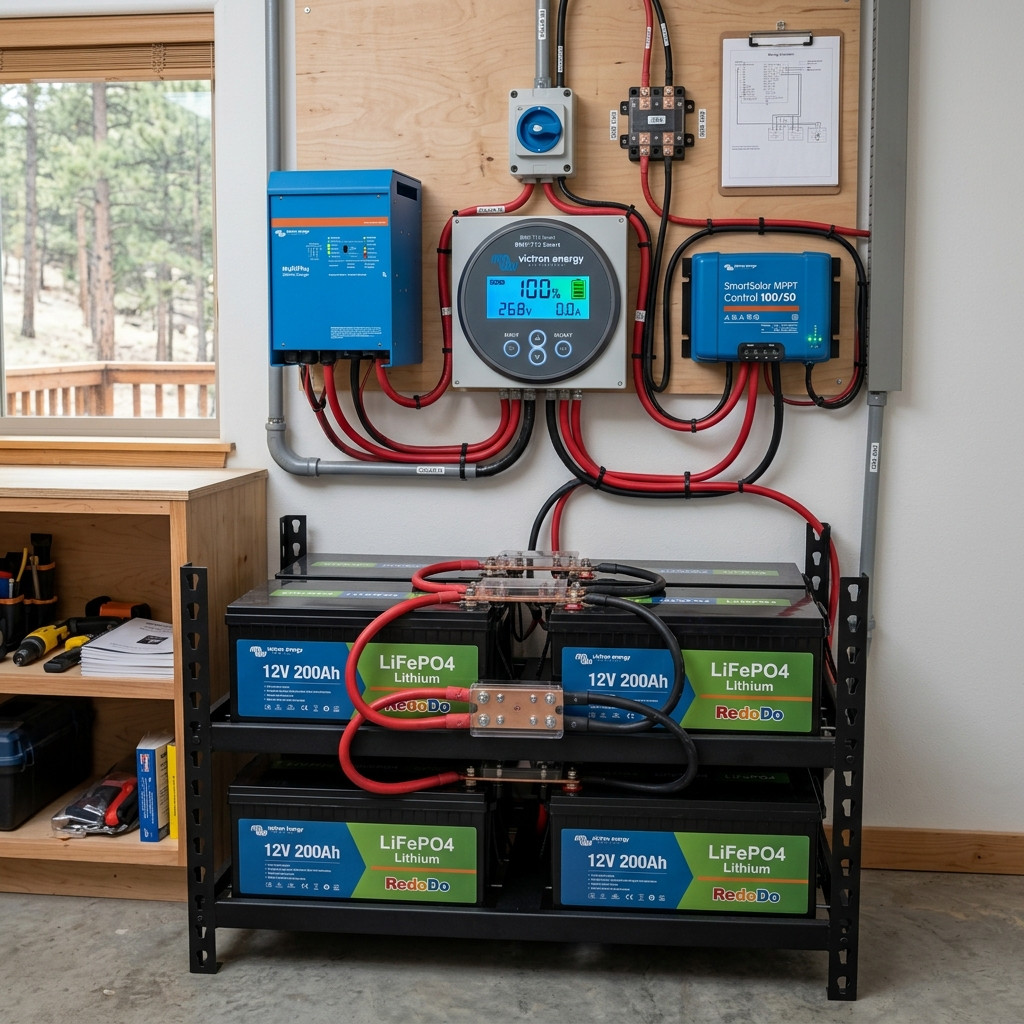
The quiet appeal of off-grid living is often interrupted by a sudden, high-pitched beep. That sound is the low-voltage alarm on your battery monitor, signaling that your off-grid dwelling is about to plunge into darkness. It is a common frustration for those who venture away from shore power connections without a properly sized energy storage system.
Determining exactly how much battery capacity you need for boondocking is the difference between a peaceful, self-sustaining retreat and a stressful exercise in power conservation. Your battery bank is the heart of your living space's electrical system, storing the energy harvested by your solar panels and distributing it to your lights, refrigeration, water pump, and personal electronics.
To build a system that never leaves you stranded, you must understand your daily consumption, the structural differences between battery chemistries, and how to plan for days when the sun refuses to shine.
Key Takeaways
- Chemistry Matters: Traditional lead-acid batteries only offer 50% usable capacity, whereas lithium (LiFePO4) batteries safely provide 80% to 100% of their rated capacity.
- Establish a Baseline: Accurate sizing requires calculating your daily Watt-hour or Amp-hour consumption before buying any hardware.
- Plan for Autonomy: A resilient system includes a safety margin of 2 to 3 days of autonomy to carry your dwelling through cloudy weather.
- Inverter Losses: Always account for a 10% to 15% energy loss when converting DC battery power to AC household electricity.
Decode Your True Battery State of Charge:
LiFePO4 voltage curves are deceptive. Use our Battery SoC & Voltage Interpreter to read exact capacity from resting voltage, or tune your charge profile using the LiFePO4 Controller Settings Finder.
The Foundation: Knowing Your Daily Power Usage
You cannot size a battery bank based on guesswork or generalized recommendations. A system that works perfectly for a minimalist living in a small cabin will fail instantly for a remote worker running multiple laptops, a residential refrigerator, and a microwave inside a spacious mobile dwelling.
To get an accurate starting point, you first need to determine how much electricity does an RV use per day based on your specific appliances. This involves listing every electrical device you plan to run, noting its wattage, and estimating the number of hours it will operate daily.
Multiply the wattage of each appliance by its daily run time to find the total Watt-hours (Wh) consumed. For example, a 10-watt LED light bulb running for 5 hours consumes 50 Watt-hours. Summing these values across all your devices gives you the daily energy budget that your battery bank must support.
Deciphering the Units: Amp-Hours vs. Watt-Hours
When shopping for deep-cycle batteries, you will encounter two primary units of measurement: Amp-hours (Ah) and Watt-hours (Wh). Understanding these units is easier once you master RV solar terminology explained, which clarifies how volts, amps, and watts interact.
Amp-hours measure electrical charge over time at a specific nominal voltage (usually 12V, 24V, or 48V in off-grid setups). Watt-hours measure the total electrical energy regardless of the voltage. You can easily convert between the two using a simple formula:
Watt-hours (Wh) = Amp-hours (Ah) × Voltage (V)
For instance, a standard 100Ah lithium battery rated at 12.8 volts holds approximately 1,280 Watt-hours of energy. If your daily energy consumption is 2,500 Wh, you will need a battery bank that can deliver at least that much energy, adjusted for system efficiencies and depth of discharge limitations.
The Usable Capacity Trap: Lithium vs. Lead-Acid
One of the most common mistakes off-grid builders make is looking only at the nominal rating printed on the battery casing. A 100Ah lead-acid battery and a 100Ah lithium battery do not deliver the same amount of usable energy. This discrepancy comes down to the safe Depth of Discharge (DoD) for each chemistry.
Lead-Acid Batteries (AGM and Gel)
Traditional lead-acid batteries, including Absorbed Glass Mat (AGM) and Gel variants, should never be discharged below 50% of their total capacity. Routinely draining a lead-acid battery past this midpoint causes permanent chemical degradation, drastically shortening its overall lifespan.
Consequently, if you purchase a 200Ah AGM battery bank, you only have 100Ah of usable capacity. Failing to account for this 50% limit will cause your system to fail prematurely and force you to run generators or alternative charging sources far more often than planned.
Lithium Iron Phosphate (LiFePO4) Batteries
Modern lithium chemistry has revolutionized off-grid living. LiFePO4 batteries can safely handle a Depth of Discharge between 80% and 100% without damaging the internal cells. Most high-quality lithium batteries feature built-in Battery Management Systems (BMS) that protect them from over-discharge while allowing you to use virtually every Amp-hour you paid for.
This means a single 100Ah lithium battery provides the same amount of usable energy as a bulky, much heavier 200Ah lead-acid battery. When you factor in the weight savings, faster charging profiles, and longer cycle life, lithium consistently proves to be the more cost-effective choice for serious off-grid use.
The Autonomy Factor: Planning for Cloudy Days
Autonomy refers to the number of days your battery bank can power your living space without receiving any charge from your solar panels or an external generator. If you size your battery bank to cover exactly one day of power, a single afternoon of heavy rain or thick cloud cover will leave you in the dark.
For reliable boondocking, a standard recommendation is to build in 2 to 3 days of autonomy. This buffer ensures that your critical appliances, such as your water pump and refrigerator, continue to run smoothly even during consecutive days of poor weather.
To calculate your total required capacity with autonomy in mind, multiply your daily usable Amp-hour requirement by your target days of autonomy, then adjust for your chosen battery chemistry's discharge limit.
Autonomy Days Sizing Chart
The table below illustrates the total battery capacity required based on daily energy consumption and target days of autonomy. It compares the physical capacity needed for both lead-acid (50% DoD) and lithium (90% DoD) systems at a standard 12-volt nominal rating.
| Daily Usable Need (Ah @ 12V) | Days of Autonomy | Total Usable Ah Needed | Required Lead-Acid Bank (50% DoD) | Required Lithium Bank (90% DoD) |
|---|---|---|---|---|
| 50 Ah (Minimalist) | 2 Days | 100 Ah | 200 Ah | 111 Ah |
| 100 Ah (Moderate) | 2 Days | 200 Ah | 400 Ah | 222 Ah |
| 100 Ah (Moderate) | 3 Days | 300 Ah | 600 Ah | 333 Ah |
| 200 Ah (Heavy User) | 2 Days | 400 Ah | 800 Ah | 444 Ah |
Step-by-Step Sizing Guide with Inverter Losses
When electricity travels from your battery bank through an inverter to power 120V AC household appliances (like a coffee maker or microwave), some energy is lost as heat. Standard off-grid inverters operate at roughly 85% to 90% efficiency.
To prevent these losses from draining your system unexpectedly, you must factor an efficiency multiplier into your calculations. Follow this step-by-step method to find your final battery capacity requirement:
Step 1: Separate DC and AC Loads
List your DC loads (12V lights, water pump, USB ports) and your AC loads (microwave, laptop chargers, TV) separately. Let's assume your DC loads consume 40Ah per day, and your AC loads consume 1,200 Watt-hours per day at 12V.
Step 2: Convert AC Watt-Hours to Amp-Hours
Convert your AC Watt-hours to Amp-hours by dividing by your system voltage (12V):
1,200 Wh / 12V = 100 Ah
Step 3: Apply the Inverter Efficiency Factor
Divide your AC Amp-hour consumption by an average inverter efficiency of 85% (0.85):
100 Ah / 0.85 = 117.6 Ah
Step 4: Combine the Loads
Add your native DC loads to your adjusted AC loads to find your true daily consumption:
40 Ah (DC) + 117.6 Ah (AC) = 157.6 Ah per day
Step 5: Multiply for Autonomy and Chemistry
If you want 2 days of autonomy using a lithium battery bank with a safe 90% depth of discharge, apply the following calculation:
(157.6 Ah × 2 days) / 0.90 = 350.2 Ah
In this scenario, a 350Ah to 400Ah lithium battery bank will provide a highly reliable, stress-free off-grid experience.
Real-World Sizing Profiles
To help visualize how these numbers translate to actual off-grid living, let's look at three common user profiles and the battery banks that suit them best.
The Weekend Minimalist (100Ah Lithium / 200Ah AGM)
This setup is designed for those who keep things simple. You run efficient LED ceiling lights, a water pump, charge two smartphones, and run a small 12V portable fridge. Your daily power consumption hovers around 30 to 40 Ah. A single 100Ah lithium battery easily provides more than two days of power without needing a charge.
The Full-Time Remote Worker (300Ah to 400Ah Lithium)
This profile represents those who live off-grid while maintaining a modern digital lifestyle. You run a compressor refrigerator, a pressure pump, ventilation fans, a starlink internet terminal, two laptops for eight hours a day, and an occasional kitchen appliance via a 2,000-watt inverter. Daily consumption averages 120 to 150 Ah, making a 300Ah to 400Ah lithium bank the sweet spot for stability.
The High-Demand Glamping Setup (600Ah+ Lithium)
If you refuse to compromise on comfort, this is your category. You run a residential refrigerator, a microwave, a coffee maker, entertainment systems, and want the ability to run an efficient air conditioning unit for a few hours during hot afternoons. Your consumption can easily exceed 300Ah per day. To support this lifestyle, you will need at least 600Ah of lithium storage paired with a massive solar array.
Temperature and Environmental Considerations
Batteries are chemical devices, meaning their performance is directly tied to the ambient temperature of their environment. Cold weather reduces the chemical activity inside both lead-acid and lithium cells, temporarily lowering their effective capacity.
Standard lead-acid batteries can lose up to 30% of their rated capacity when temperatures drop near freezing. While lithium batteries perform better in the cold, they face a unique safety constraint: they cannot be charged when internal cell temperatures fall below freezing (32°F / 0°C).
If you plan to boondock in cold northern climates during the winter, look for lithium batteries equipped with internal heating blankets. These systems use a tiny fraction of incoming solar power to warm the battery cells to a safe charging temperature, protecting your investment from permanent cold-charging damage.
Balancing Your Battery Bank with Your Solar Array
A massive battery bank is useless if you do not have the means to charge it. Your energy storage capacity must be balanced with an appropriately sized solar array. As a general rule of thumb, aim for a 2:1 ratio of solar wattage to lithium battery Amp-hours.
For example, if you install a 200Ah lithium battery bank (approx. 2,560 Wh), you should pair it with at least 400 watts of solar panels. This ratio ensures that during a standard day with 4 to 5 hours of usable sunlight, your solar panels can fully replenish the energy you consumed the previous night.
Frequently Asked Questions
Can I mix different battery brands or sizes in my bank?
No. You should never mix batteries of different brands, capacities, ages, or chemistries within the same bank. Doing so causes uneven current distribution, forcing one battery to work harder than the others, which leads to premature system failure and potential safety hazards.
How long do lithium batteries last compared to lead-acid?
High-quality LiFePO4 batteries typically last between 3,000 and 5,000 charge cycles at an 80% depth of discharge. In contrast, AGM lead-acid batteries generally offer 300 to 500 cycles when discharged to 50%. This means a lithium bank can easily last 10 years or more, outliving multiple sets of lead-acid batteries.
Do I need a special charge controller for lithium batteries?
Yes. Lithium batteries require a specific charging profile that includes a constant current phase followed by a constant voltage phase, without a prolonged float or equalization stage. Ensure your solar charge controller has a dedicated "Lithium" or "LiFePO4" setting to prevent overcharging.
Is it better to build a 12V, 24V, or 48V battery system?
For small to moderate systems under 3,000 watts, a standard 12V system is simple and compatible with most native DC appliances. For larger systems with high-power inverters, upgrading to a 24V or 48V configuration reduces current draw, allows for thinner wiring, and improves overall system efficiency.
Securing Your Off-Grid Power Independence
Sizing your battery bank correctly is the most critical step in designing a reliable off-grid power system. By calculating your true daily energy consumption, accounting for inverter inefficiencies, and choosing the right chemistry for your climate, you can head out into the wild with complete confidence.
Investing in a high-quality lithium battery bank that offers a comfortable cushion of autonomy means you can focus on enjoying the peace of your surroundings, rather than constantly monitoring your control panel and dreading the next low-voltage alarm.