
Rigid vs Flexible RV Solar Panels: Pros, Cons and Real-World Problems
This post contains affiliate links — if you buy through them, we may earn a commission at no extra cost to you.
Key Takeaways
- Rigid aluminum-framed panels typically last 20-25+ years and hold their rated output better over time than flexible panels.
- Flexible panels usually run hotter in direct sun — often 10-20°F warmer than a framed panel with an air gap — which reduces real-world output.
- Flexible panels commonly carry 3-5 year warranties versus 10-25 years for rigid glass panels, reflecting the manufacturer's own durability expectations.
- Curved-roof RVs (teardrops, some fiberglass trailers, aerodynamic van conversions) are the main legitimate case for flexible panels — not weight savings alone.
- Rigid panels remain the better default for flat-roof travel trailers, fifth wheels, and most Class A/C motorhomes.
Why This Comparison Actually Matters
Anyone shopping for RV solar panels eventually runs into the rigid-versus-flexible question, usually for one of two reasons: the roof isn't flat, or the panel looks too heavy for the rig. Both are legitimate concerns. But the marketing around flexible panels — "lightweight," "low profile," "easy install" — glosses over the trade-offs that show up months or years into ownership.
This isn't a case where one type is universally better. It's a case where the right answer depends on your roof shape, your climate, your budget, and how long you expect to keep the panels installed. Below is what actually differs between the two, based on how each panel type is built and how that construction behaves outdoors.
How Rigid and Flexible Panels Are Actually Built
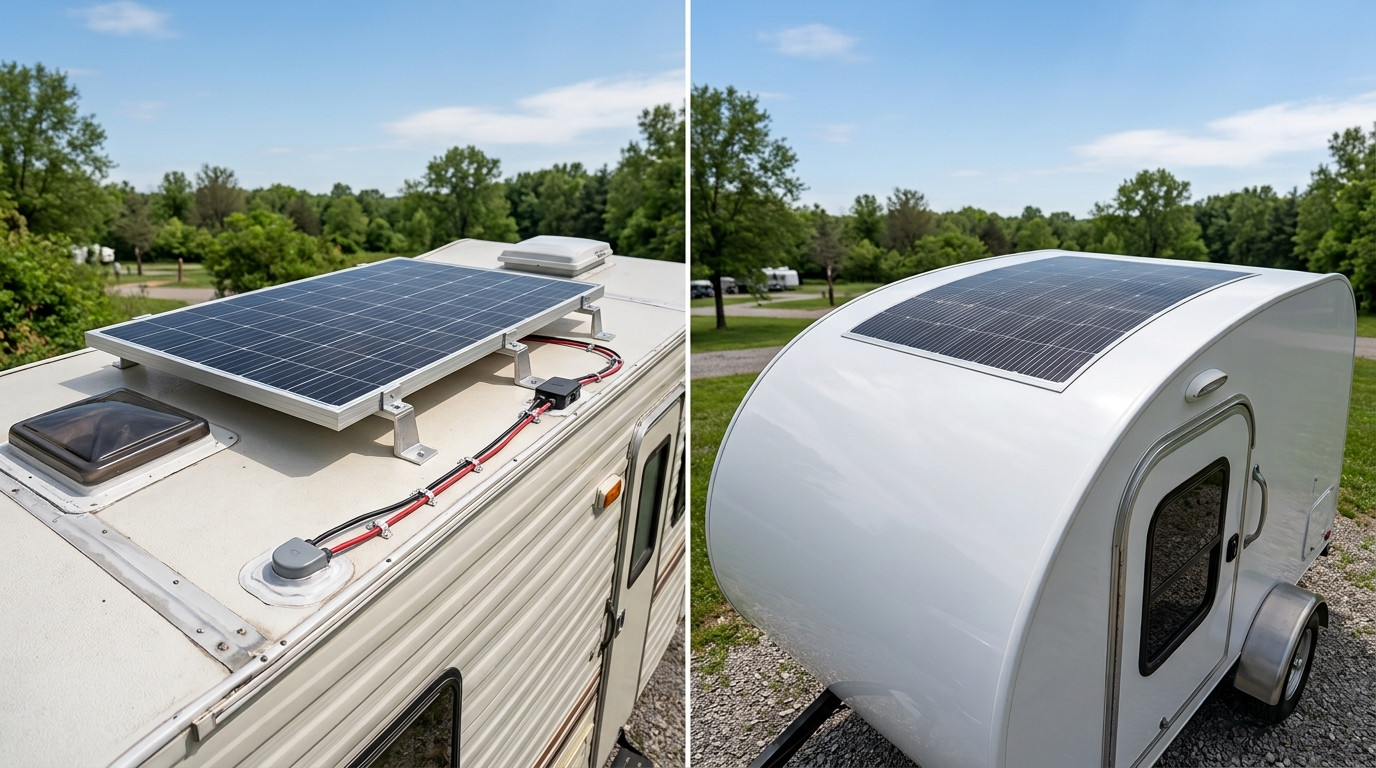
A rigid RV solar panel uses standard crystalline silicon cells sandwiched between a tempered glass front sheet and a rigid backsheet, held in an aluminum frame. The glass layer and frame are what give the panel its structural strength, its weight (roughly 0.4-0.5 lb per watt including frame), and its thickness — typically 1.0-1.4 inches.
A flexible panel uses the same type of silicon cells, but instead of glass, the front layer is a thin, UV-resistant polymer — commonly ETFE (ethylene tetrafluoroethylene) on better panels, or a less durable PET laminate on cheaper ones. There's no aluminum frame; the panel is typically 3-5mm thick and can bend to follow a curved surface, usually rated for a bend radius somewhere around 30-40 degrees depending on the model. That flexibility is also where most of the panel's long-term weaknesses originate.
Durability: This Is Where the Real Difference Shows Up
Glass is chemically inert and doesn't degrade from UV exposure. The polymer front sheet on a flexible panel does — slowly, but measurably. Over years of sun exposure, that laminate can yellow, become brittle, and in some cases start to delaminate at the edges, allowing moisture in around the cells.
Moisture ingress is the single most common flexible-panel failure mode reported by RV owners, and it's a direct consequence of not having a rigid glass-and-frame seal. Once moisture reaches the cells, output typically drops in a localized area first (a hot spot or dead cell string), rather than failing outright — which makes the problem easy to miss until the panel is noticeably underperforming.
Rigid panels aren't immune to failure, but their failure modes are different: cracked glass from impact (hail, falling branches, a dropped ladder) or frame corrosion at the mounting points. Both are less common than laminate degradation on flexible panels, largely because glass and aluminum simply hold up to UV and thermal cycling better than laminated polymer.
| Factor | Rigid Panel | Flexible Panel |
|---|---|---|
| Typical thickness | 1.0-1.4 in | 3-5 mm |
| Typical weight | ~0.4-0.5 lb/watt | ~0.1-0.15 lb/watt |
| Front surface | Tempered glass | ETFE or PET polymer |
| Typical manufacturer warranty | 10-25 years | 3-5 years |
| Common failure mode | Cracked glass, frame corrosion | Laminate delamination, moisture ingress |
| Mounting method | Standoff brackets (air gap) | Flush/adhesive or minimal-gap mount |
Heat: The Efficiency Problem Nobody Puts on the Spec Sheet
Every silicon solar panel loses efficiency as it gets hotter — this is a basic property of the cells, expressed on spec sheets as a "temperature coefficient," usually somewhere around -0.3% to -0.45% of output per °C above 25°C (77°F). This applies to both panel types equally. The difference is how hot each type actually gets while sitting on your roof.
Rigid panels are almost always installed on standoff brackets that leave a 1-2 inch air gap between the panel and the roof. That gap lets air circulate underneath and carry heat away. Flexible panels are frequently mounted flush or with adhesive directly against the roof surface — partly because that's the low-profile installation they're marketed for — which traps heat against the panel and the roof membrane underneath.
The practical result: on a hot, sunny day, a flush-mounted flexible panel can run noticeably hotter than a rack-mounted rigid panel under identical sun conditions. Given a typical temperature coefficient, that heat difference alone can cost several percent of rated output during peak sun hours — on top of whatever efficiency the panel already loses from being warmer than the standard 77°F test condition all silicon panels are rated at.
Worked example, stated with assumptions: A 200W flexible panel flush-mounted on a black rubber roof in Arizona summer sun might reach a cell temperature of 140-150°F, compared to maybe 120-130°F for a rack-mounted rigid panel in the same conditions (these are illustrative ranges, not universal figures — actual temperatures depend on roof color, ambient temperature, wind, and panel-specific ventilation). At a coefficient of -0.4%/°C, the difference between those two temperature ranges is roughly 4-6 percentage points of output — meaningful, but not catastrophic, and it doesn't make flexible panels non-viable. It does mean the "200W" printed on the panel is a lab number you're less likely to see in practice with a flush flexible install.
Lifespan and What It Means for Total Cost
Rigid panels are commonly rated for 25-year performance warranties, with manufacturers guaranteeing something like 80-87% of original output at the 25-year mark — the same standard used in residential solar. Many rigid RV panels in real-world use continue producing usable power well past that point, just at reduced output.
Flexible panels rarely carry warranties longer than 3-5 years, and that's not an arbitrary marketing choice — it reflects the manufacturer's own confidence in how long the laminate will hold up before degradation becomes a real problem. Anecdotally, RV owners in online forums frequently report noticeable output decline or panel failure in the 3-7 year range, which lines up with the shorter warranty period rather than contradicting it.
This changes the real cost comparison. A flexible panel usually costs less per watt upfront, but if it needs replacing in year 5 while a rigid panel is still going strong at year 15, the rigid panel can end up cheaper per year of service — even though the sticker price was higher on day one.
When Flexible Panels Actually Make Sense
This isn't a "never buy flexible" article. There are specific situations where flexible panels are the right call, and it usually comes down to roof geometry rather than preference:
- Genuinely curved roofs — teardrop trailers, some fiberglass-molded trailers (like Scamp or Casita-style rigs), and aerodynamic van conversions with rounded roof edges where a rigid panel physically can't sit flush.
- Portable or supplemental panels — a flexible panel used as a temporary ground-deployed or lean-against-the-rig backup, where it's not permanently exposed to weather 24/7 and gets stored when not in use.
- Extreme weight-sensitive builds — very small teardrops or ultralight van builds where every pound genuinely affects towing capacity or payload margin, and the owner accepts a shorter panel lifespan as a trade-off.
- Low-clearance storage requirements — RVs stored in a garage or carport with height restrictions where even a 1.2-inch rigid panel profile is the difference between fitting and not fitting.
Outside of these situations, a flat or nearly-flat roof on a travel trailer, fifth wheel, or standard motorhome almost always favors rigid panels, as covered in more detail when comparing 100W vs 200W vs 400W RV solar systems for different roof layouts.
If You Do Go Flexible: How to Reduce the Downsides
For owners whose roof genuinely requires flexible panels, a few installation choices meaningfully reduce the heat and moisture issues described above:
- Leave an air gap where possible. Some flexible panels can be mounted on thin standoffs or spacer strips rather than fully flush, which helps with cooling even without a full rack.
- Choose ETFE over PET laminate. ETFE-fronted panels cost more but resist UV degradation and yellowing significantly better than cheaper PET-laminate panels.
- Seal edges carefully and re-inspect annually. Since moisture ingress starts at the edges, a proper butyl or specialized flexible-panel sealant at installation — and a yearly check for lifting edges — catches problems before they reach the cells.
- Avoid full adhesive-only mounting on dark roofs. A fully glued-down panel on a black or dark-colored roof membrane maximizes heat buildup; check whether the manufacturer allows a partial-gap mount instead.
Connecting This to Your Solar Sizing Decision
Panel type doesn't change how much wattage you actually need — that's still driven by your daily energy consumption, which is covered in detail in what an RV solar system actually powers. What panel type changes is how much of your rated wattage you'll realistically collect on a hot day, and how long the panels will keep producing near that rating before performance drops off.
As a rough planning adjustment: if you're set on flexible panels for roof-shape reasons, consider sizing 10-15% above what a straight wattage calculation suggests, to offset the heat-related output loss discussed above. That's a planning buffer based on the temperature-coefficient math above, not a guaranteed number — actual losses vary by climate, roof color, and specific panel model.
The Bottom Line
Rigid panels win on durability, lifespan, and real-world output in hot conditions, and they remain the default recommendation for the vast majority of flat-roof RVs. Flexible panels solve a genuine problem — curved roofs and hard weight limits — but that problem-solving comes with a real trade-off in panel lifespan and heat performance that's worth going in with open eyes about, rather than discovering it three summers in.
If your roof is flat, there's rarely a good reason to choose flexible over rigid. If your roof isn't flat, flexible panels are a legitimate solution — just budget for a shorter service life and consider the mounting adjustments above to get more out of them while they last.