
How Much Solar Power Does an RV Panel Produce in Real Conditions?
Key Takeaways
- A panel's rated wattage is measured at 25°C cell temperature and direct, unshaded sunlight — conditions an RV roof rarely matches.
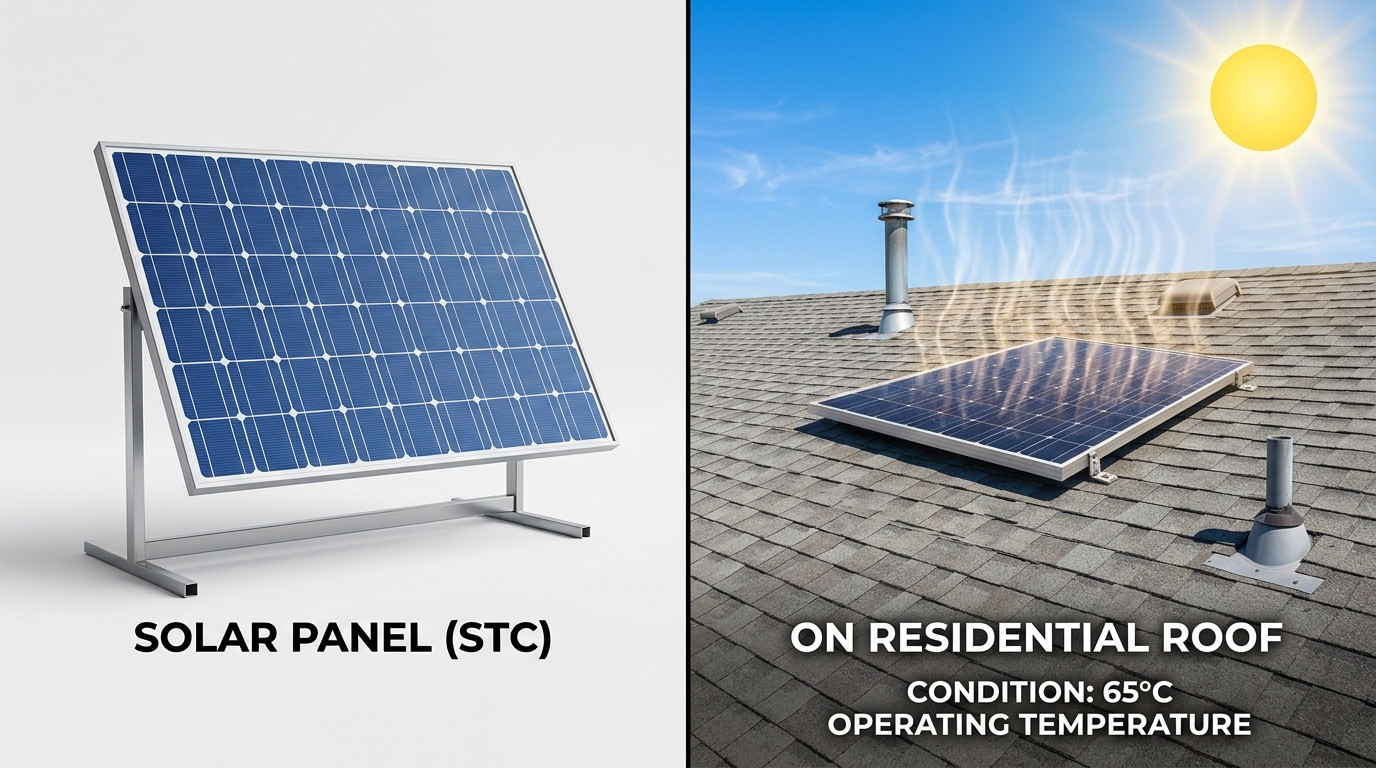
- Heat is the biggest silent loss. A typical monocrystalline panel loses roughly 0.3% to 0.5% of output for every degree Celsius its cell temperature rises above 25°C — and roof-mounted cells commonly run 20-25°C hotter than the air around them.
- Sun angle matters almost as much as heat. A panel angled 30° off the sun can lose 15% or more of its potential output, which is why flat roof-mounted panels underperform tilted portable ones at low sun angles.
- Shade is disproportionately damaging — a small shadow across one cell can cut a whole string's output far more than the shaded area alone would suggest.
- After combining these losses, a realistic full-sun day for a roof-mounted RV system typically nets somewhere around 65-80% of the panel's rated wattage at peak output, not 100%.
Most RV owners run the same math at some point: a 200-watt panel, five hours of "good sun," so 1,000 watt-hours a day, right? Then the battery monitor tells a different story. The gap isn't a defective panel or bad luck — it's the difference between a lab rating and a rooftop in the real world.
The panel's wattage number on the spec sheet is real, but it's measured under Standard Test Conditions: 25°C cell temperature, 1,000 W/m² of sunlight hitting the panel dead-on, and a specific light spectrum. An RV panel almost never sees all three of those at once. Understanding why closes the gap between what the label promises and what actually reaches the battery.
Why the Rated Watts Number Is a Lab Result, Not a Forecast
Every solar panel sold for RV use carries a Standard Test Condition (STC) rating — the number printed on the panel and used in marketing. It's measured indoors or under controlled outdoor conditions with the cell held at exactly 25°C, full sun intensity, and light striking the panel surface at a perfect 90-degree angle.
That's a useful, standardized way to compare panels against each other. It is not a prediction of daily output. On an actual RV roof, the cell is usually hotter than 25°C, the sun rarely hits the fixed panel at a perfect angle for more than a few minutes a day, and something — an AC unit, a roof vent, a tree branch — is often casting a partial shadow at some point in the day. Each of these factors pulls real output below the rated number, and the article covering what watts, voltage, and current actually mean on an RV panel is a useful companion piece for the underlying electrical terms used here.
Temperature: The Loss Most RV Owners Don't Expect
It seems backwards, but solar panels lose efficiency as they get hotter, even though heat obviously means more sun. The relationship between a panel's power output and its temperature is described by a spec sheet number called the temperature coefficient of Pmax, usually written as a negative percentage per degree Celsius.
Most monocrystalline panels — the type used on the large majority of RV installations — carry a temperature coefficient somewhere between -0.3%/°C and -0.5%/°C, with -0.4%/°C being a common figure across popular RV panel models. That means for every degree the cell rises above the 25°C STC baseline, output drops by roughly that percentage.
The part that catches people off guard is how hot a roof-mounted panel actually gets. A dark-colored panel sitting flat on a light-colored RV roof under full midday sun commonly runs 20-30°C hotter than the surrounding air temperature, because there's little airflow underneath it to carry heat away.
A Worked Example
Take a 200-watt panel with a -0.4%/°C temperature coefficient, mounted flat on the roof. On a warm 30°C (86°F) day, if the panel's cell temperature reaches 55°C — a realistic number for a flat roof mount in full sun — that's 30°C above the 25°C STC baseline.
- Temperature loss: 30°C × 0.4%/°C = 12% output reduction
- Adjusted output: 200W × (1 − 0.12) = 176W at peak conditions
On a cold, clear winter day, the same math works in the panel's favor. If the cell only reaches 10°C, that's 15°C below the baseline, giving a theoretical 6% gain — which is why cold, sunny days can sometimes outperform hot, sunny ones on a watt-for-watt basis, assuming there's no snow blocking the panel.
This is also a practical argument for gap-mounting or tilt-mounting panels rather than laying them flush against the roof. A few inches of airflow underneath a panel measurably lowers cell temperature and recovers some of this loss — it's a small mounting decision with a real output effect.
Sun Angle: The Loss That Changes All Day Long
A solar panel produces its rated output only when sunlight hits it at a 90-degree angle — straight on. As that angle changes, output falls off following what's known as the cosine effect: the more oblique the angle, the less usable light energy actually strikes the cell per square inch of panel.
For a flat roof-mounted panel, this angle is fixed relative to the RV, but it changes constantly relative to the sun as the sun moves across the sky and as the sun's seasonal height in the sky shifts. A panel that's perfectly angled to the sun at solar noon in June will be significantly off-angle by 9 a.m., by 4 p.m., and again in December when the sun sits much lower.
| Angle Off Direct Sun | Approximate Output Loss | What This Looks Like |
|---|---|---|
| 0° (direct) | 0% | Panel facing the sun straight on, typically only for a short window near solar noon |
| 15° | ~3% | Mid-morning or mid-afternoon on a flat roof mount |
| 30° | ~13% | Early morning, late afternoon, or a flat mount in winter |
| 45° | ~29% | Low winter sun angle hitting a flat roof panel |
| 60°+ | 50% or more | Very low sun, common near sunrise/sunset or in far northern winter latitudes |
This is exactly why portable panels that can be angled and repositioned toward the sun — the kind covered in the article on real-world tested portable RV solar panels — often out-produce a same-wattage roof-mounted panel on the same day, especially outside the summer months. A flat roof panel accepts the cosine loss all day; a tilted, sun-tracking portable panel minimizes it during the hours it matters most.
Shade: A Small Shadow, a Disproportionate Loss
Of the three factors covered here, shade is the one that behaves least intuitively. Most RV solar panels are built from cells wired in series strings. When even one cell in that string is shaded, it doesn't just lose its own small share of output — it restricts current flow for the entire string, because current in a series circuit is limited by the weakest link.
Quality panels include bypass diodes that reroute current around a shaded section rather than letting the whole panel collapse to near zero, but even with bypass diodes working correctly, a shadow covering roughly 10% of a panel's surface can cut total output by 30% or more, not 10%. A rooftop AC unit's shadow crossing a panel for even part of the day, or a low tree branch at a campsite, can be a bigger factor than most RV owners assume.
This is a strong practical argument for checking a parking or camping spot for shadow paths — from roof equipment, awnings, or trees — before assuming a "sunny-looking" site will actually deliver full output for the panels installed.
Putting the Losses Together: A Realistic Output Percentage
None of these three factors act alone — a real RV panel deals with some combination of heat, angle, and occasional partial shade throughout the day, on top of smaller factors like dust, wiring resistance, and charge controller conversion efficiency (typically 95-99% for a quality MPPT controller).
Stacking realistic values for temperature loss (roughly 5-12% depending on climate), angle loss across a full day (roughly 10-20% when averaged rather than measured only at solar noon), and minor system losses (roughly 3-5%) lands most flat, roof-mounted RV panels at approximately 65-80% of their STC-rated wattage during their best sun hours on a clear day — not for the whole day, just during peak conditions. Cloud cover, shorter winter days, and partial shade push the realistic daily energy total lower still.
Worked Example: A 200W Roof-Mounted System
Assume a 200W panel, 5 hours of usable daily sun (a reasonable average for many U.S. boondocking locations outside deep winter), and a realistic 70% derate factor covering combined temperature, angle, and system losses:
- Rated math (what the label suggests): 200W × 5 hours = 1,000Wh/day
- Realistic math (accounting for real conditions): 200W × 0.70 × 5 hours = 700Wh/day
That 300Wh difference is the exact gap that leaves many RV owners confused about why their battery isn't recovering as expected. It's also the reason sizing guidance that assumes 100% of rated wattage tends to under-deliver in practice — a point covered in more depth in the comparison of 100W vs. 200W vs. 400W RV solar systems, and in the breakdown of what a 200W system can actually run once real-world derating is factored in.
These figures will shift with location, season, and panel quality — a cloudy Pacific Northwest winter day and a clear Arizona summer day are not the same 5 "sun hours," even if both get logged that way. Treat the 65-80% range as a planning baseline, not a guaranteed number for every site and season.
What This Means for Sizing Your System
The practical takeaway isn't that solar panels underperform or aren't worth installing — it's that sizing decisions should be based on realistic harvest, not the number printed on the panel. When calculating how much solar capacity is needed to cover daily energy use, applying a 65-75% derate factor to the panel's rated wattage before doing the math produces a far more reliable estimate than assuming full rated output for every sunny-looking hour.
In practice, this usually means slightly oversizing the solar array relative to a "perfect conditions" calculation, choosing tiltable or gap-mounted panels where roof space allows, and being realistic about how many genuinely unobstructed sun hours a typical boondocking day provides — rather than counting every hour between sunrise and sunset as full-value solar time.