
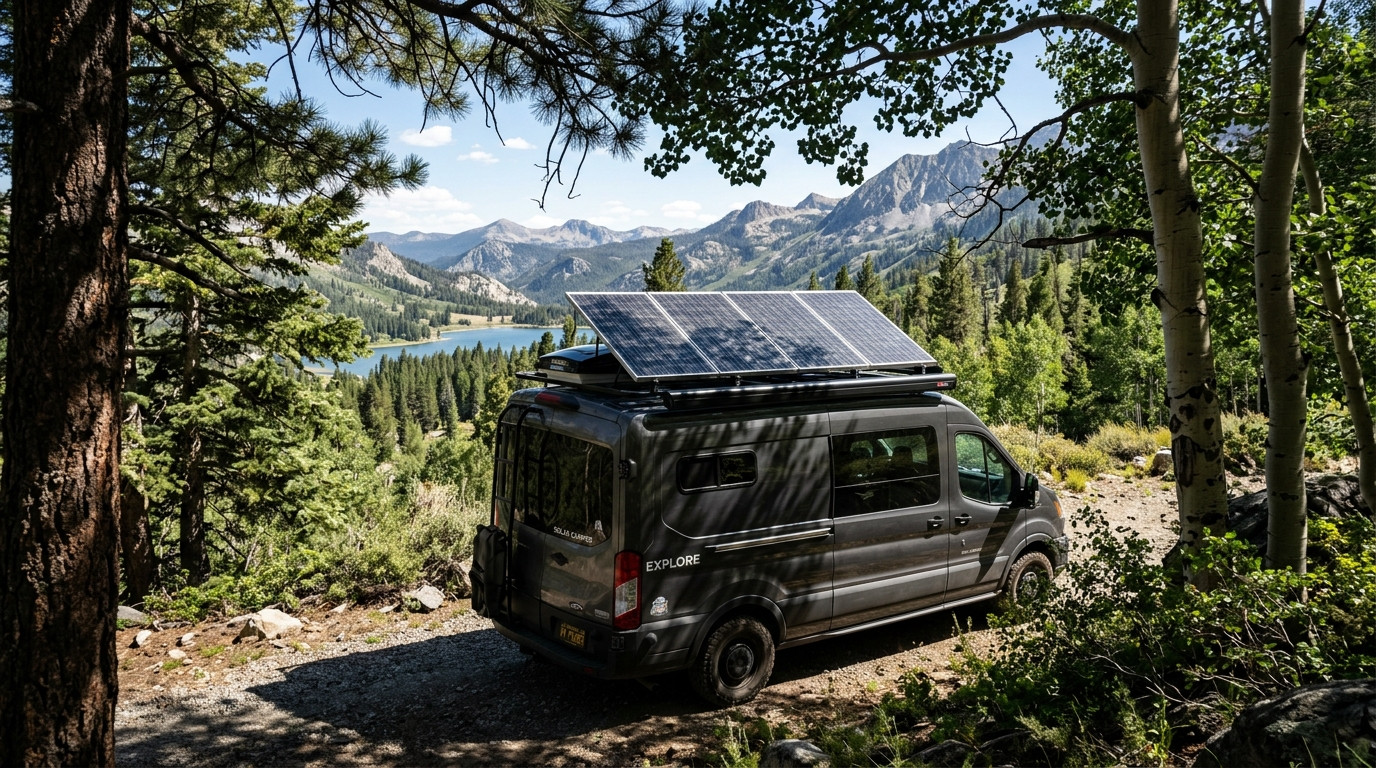
RV Solar Panels in Shade: How Much Power Do You Lose?
You pull into a site with big trees, gorgeous shade, and a slightly worried feeling about your batteries. The panels are still bolted to the roof and technically "getting light," but the charge controller display is barely moving. This is one of the most common boondocking surprises, and the honest answer is that shade doesn't just reduce solar output proportionally — it can wipe out far more power than the shaded area alone would suggest.
Key Takeaways
- Partial shading on even one cell can cut a panel's output by a disproportionate amount — often 50% or more — not just the percentage of the panel physically covered.
- The reason is wiring, not sunlight math: most RV panels wire their cells in series, so the shaded cell limits current for the whole string unless bypass diodes intervene.
- A portable, ground-deployed panel that you can physically move into sun is usually a more reliable fix than trying to out-engineer a permanently shaded roof mount.
- Boondockers who regularly camp in wooded or canyon sites should size battery reserve for 1.5–2 "low-production days" in a row, not just an average sunny day.
Why Shade Costs More Power Than It Looks Like It Should
Most people assume shade works like a dimmer switch — cover a quarter of the panel, lose roughly a quarter of the power. That assumption is wrong for the way most RV solar panels are actually built, and understanding why matters more than any specific number.
A typical rigid or semi-flexible RV panel is made of dozens of individual solar cells wired in series inside the panel, then several panels wired in series again to reach the voltage your charge controller wants. In a series circuit, current can only flow as fast as the weakest link allows. A single shaded cell produces far less current than its unshaded neighbors — and because they're all in the same series string, the whole string gets throttled down to whatever that one weak cell can pass.
Panel manufacturers build in bypass diodes to limit the damage. These diodes let current skip around a shaded section instead of forcing the whole panel through it. Most 100W–200W RV panels have their cells split into two or three sections, each with its own bypass diode. That helps, but it doesn't eliminate the loss — it just contains it to that one section instead of killing the entire panel.
Shade Impact by Type: What Actually Happens
The type of shade matters as much as the amount. A thin, moving shadow behaves very differently from a solid, stationary one, even if they cover a similar area at any given moment.
| Shade Type | Typical Coverage | Approximate Output Impact | Why |
|---|---|---|---|
| Thin branch or antenna shadow moving across the panel | Under 5% of surface | Moderate, often 20–40% loss while the shadow crosses affected cells | Even a narrow line can fall across an entire cell width, dragging down its whole series section |
| One full panel of a multi-panel array shaded solid | 1 of 2–4 panels, ~25–50% of array area | Can approach 50% or more of total array output, not just the shaded fraction | If panels are wired in series with each other, the shaded panel limits current for the string it's part of |
| Dappled, shifting leaf shade (light tree cover) | Variable, patchy | Highly variable, commonly 30–60% loss over the course of a shaded period | Constantly changing shadow patterns mean different cells are throttled from minute to minute |
| Full solid shade (parked directly under dense canopy) | Most or all of the array | Often 70–90%+ loss | Diffuse light under dense canopy carries far less usable irradiance even where no direct shadow line exists |
These figures are illustrative ranges based on how series-wired solar cells and bypass diodes behave, not measurements from a specific test unit — real numbers vary by panel design, wiring configuration, and how much of the array is affected at once. The pattern that holds consistently is this: shade losses are almost always worse than the shaded area alone suggests, especially with older or simpler panels that only have one or two bypass diode sections.
Wiring Matters As Much As Shade Location
If you're running multiple panels, how they're wired changes how badly shade hurts you. This is worth understanding even if you didn't design the system yourself, because it explains why two RVs with "the same" solar setup can react very differently to the same tree.
- Series-wired arrays (common for reaching higher charge controller input voltage) are the most vulnerable — one shaded panel can drag down the whole string's current.
- Parallel-wired arrays are more shade-tolerant — a shaded panel loses its own output, but unshaded panels keep producing closer to their normal current independently.
- Series-parallel combinations, common in 3–4 panel setups, fall somewhere in between depending on which panels end up in the same series string.
If you're deciding between a 100W, 200W, or 400W setup and you know you'll frequently camp in shaded or wooded sites, ask your installer or kit description specifically how the panels are wired together — not just their total wattage.
The Portable Panel Solution
The most reliable fix for shade isn't a smarter roof-mounted array — it's the ability to move a panel out of the shade entirely. This is exactly the gap that a portable, ground-deployable solar panel is built to fill, and it's worth treating as a real component of your system rather than a backup gadget.
A portable panel connects to your existing charge controller (either as a supplement to your roof array or through its own dedicated input, depending on your controller) and can be walked 20–50 feet away to a genuinely sunny patch of the campsite — something a roof-mounted panel obviously can't do. For readers still deciding what to buy, the comparison in real portable panel test results covers how different folding and briefcase-style panels actually perform in the field, not just their spec-sheet wattage.
A few practical notes on using a portable panel specifically to fight shade:
- Scout the site before setup — walk the campsite and identify the sunniest open patch, even if it's not adjacent to the RV. Extension cable length (many portable panels ship with 15–20 feet, extendable further) is what makes this workable.
- Reposition it through the day. A portable panel angled and moved to track the sun 2–3 times a day will meaningfully outperform a fixed roof panel sitting in dappled shade, even with less total panel area.
- Don't assume a portable panel replaces a full roof array — treat it as a shade-specific tool. On open, unshaded sites, your fixed roof array is usually more convenient and just as productive.
Worked Example: Sizing Battery Reserve for Shaded Camping
Numbers here are illustrative and depend on your actual daily consumption and battery bank — treat this as a framework to plug your own figures into, not a universal answer.
Start with a realistic daily energy draw. A moderate boondocking setup — compressor fridge, LED lighting, phone/laptop charging, water pump, occasional fan use — commonly lands around 60–100Ah per day at 12V. We'll use 80Ah/day for this example.
- Baseline daily need: 80Ah/day.
- Normal sunny-day solar recovery: A 300W array under good sun might realistically deliver 80–100Ah/day to the battery after real-world losses (wiring, controller efficiency, angle, temperature) — roughly matching daily use in decent conditions.
- Heavily shaded-day recovery: Applying a 60–70% loss (a reasonable planning assumption for a genuinely shaded site per the table above) drops that same array's output to roughly 25–40Ah/day.
- Daily shortfall in shade: 80Ah used minus ~30Ah recovered leaves a deficit of about 50Ah per shaded day.
- Reserve for consecutive shaded days: To cover two shaded days back-to-back without running critically low, you'd want roughly 100Ah of usable reserve capacity above your normal daily buffer — meaning your total usable battery capacity should comfortably exceed daily consumption by that margin.
What this means practically: if you already know a campground or region you visit regularly has heavy tree cover, size your battery bank assuming 1.5–2 low-production days in a row, not a single average sunny day. This is a different (and larger) number than most beginner sizing guides assume, and it's the gap that catches shaded-site campers off guard. For the general sizing math this builds on, how an RV solar system actually works walks through the underlying daily-use-to-battery-capacity relationship in more depth.
What Actually Changes the Estimate
These figures move around based on several variables, and it's worth being upfront about which ones matter most:
- Panel age and diode count: Older or cheaper panels with fewer bypass diode sections suffer worse shade losses than newer panels with finer-grained bypass protection.
- Time of day: Low sun angle in early morning or late afternoon already produces less output — shade during those hours compounds an already-weak period rather than cutting into peak production.
- Wiring configuration: As covered above, series vs. parallel wiring changes how much one shaded panel drags down the rest.
- Charge controller type: MPPT controllers generally handle partial shading somewhat better than PWM controllers by continuously hunting for the best available operating point, though neither eliminates the underlying series-wiring problem.
- Season and sun angle: The same tree that barely shades your roof at summer solstice can shade it for hours in fall or winter as the sun's arc lowers.
Practical Checklist for Shaded Camping
- Before committing to a site, look up — check for direct overhead branches, not just nearby trees, since overhead coverage matters most.
- If your site is shaded, deploy a portable panel in a sunny spot rather than relying on the roof array alone.
- Check your charge controller's real-time output, not just the "charging" indicator, to catch a serious production drop early.
- Reduce non-essential loads (skip the inverter-run appliances, minimize fridge door openings) on confirmed low-production days.
- If shaded camping is a regular pattern for your travel style, plan battery capacity around consecutive low-production days rather than a single average day.
Shade isn't a reason to give up on solar for wooded camping — plenty of boondockers manage it successfully. But it does mean planning for a worse-case production day rather than assuming your panels will always deliver close to their rated output. Whether that's building in a portable panel, wiring your array in parallel where possible, or simply carrying a bit more battery reserve than the "average day" math suggests, the fix is almost always about planning for variability rather than expecting it away.